
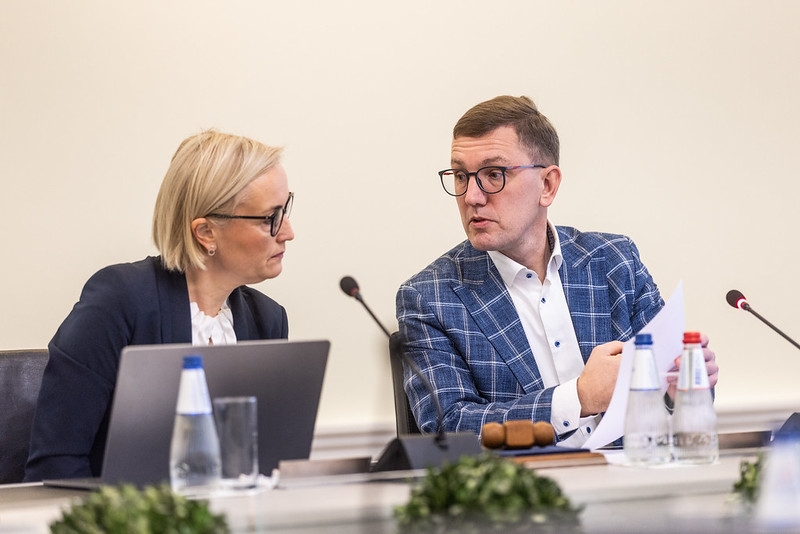
“The defence industry is part of Estonia’s defence capabilities and economic development,” Prime Minister Kristen Michal stressed. “Discussions on how to accelerate the development of the Estonian defence industry are important for our economy, on the one hand, because it provides jobs and the opportunity to increase exports, and on the other hand, it provides military assistance to Ukraine and reassurance to the people of our region.”
“The establishment of the defence industrial park is a very important step in the development of the Estonian defence industry,” emphasised Minister of Defence Hanno Pevkur, who gave the government an overview of the current status of the project. According to Pevkur, the national designated spatial plan has reached the stage of publishing the preliminary site selection and the strategic environmental assessment programme, which will make it possible to identify the most suitable areas for the establishment of the defence industrial park.
“The planning process is on track to find the most suitable site by spring 2025 and to approve the plan in August 2025,” Pevkur said.
Four sites in Ida-Viru, Lääne, and Pärnu counties have been selected for the new industrial park, potentially covering an area of 0.5–2 km2. The aim is to establish a modern industrial environment for ammunition production in Estonia..
Defence Minister Pevkur stressed that the exact size and location of the planned area will be determined based on the level of interest of companies and the government’s decision.
“Both local industry and foreign investors are keen to start large-scale production, and there is considerable interest from companies in the defence industrial park,” Pevkur said. Considering that we started with the national designated spatial plan in February this year, and that we will have the designated spatial plan in place in August next year, this is unprecedented speed. This means that industrial production could start as early as 2026 in the defence industrial park. It is in our interest that all the companies that have the capacity to operate in the defence industrial park are given that opportunity.”
The cabinet meeting also discussed Estonia’s military assistance package to Ukraine, with a focus on how this could be done through the local defence industry. Pursuant to the coalition agreement, Estonia will continue to provide military assistance to Ukraine of 0.25% of GDP, which is about 100 million euros per year. It is the largest industrial growth programme ever supported by the state.
To this end, the Ministry of Defence is in the process of preparing a support measure for donating products made by Estonian companies to Ukraine. “We want to announce the support measure as early as November,” said Defence Minister Pevkur. “Estonian companies can offer all kinds of defence and security products, including software solutions, for military assistance to Ukraine.”
Taavi Veskimägi, Chairman of the Council of the Estonian Defence and Aerospace Industry Association, outlined in his overview the sector’s ambition to increase the volume of the defence industry to two billion euros by 2030, using ground-breaking technologies. The motto of the association is “Making hardware smart”, which represents its ambition to provide smart and effective solutions for defending Estonia.
Photos of the economic cabinet can be found on the Flickr page of the Stenbock House:https://www.flickr.com/photos/stenbockimaja/albums/72177720321627494/

