
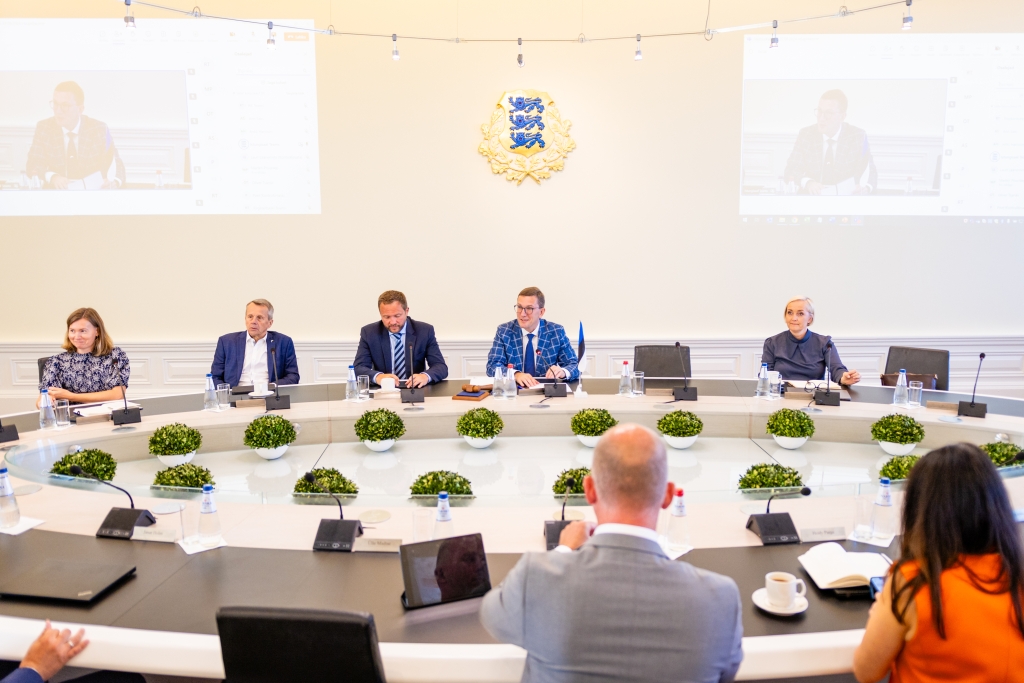
Prime Minister Kristen Michal says that the government’s aim is to boost the security of people and companies in Estonia. “In order to make the investments and secure the ammunition, manpower, medium-range air defence and other capabilities we need for our security, we will be introducing a broad-ranging security tax for a limited period, until the end of 2028,” he explained. “This is how we will be asking everyone to contribute to building a stronger Estonia. We will also be cutting public spending by 10% over three years. To keep our economy competitive we will be speeding up planning, cutting red tape, promoting clean and affordable energy and growing the defence industry, which will drive economic growth in the years ahead. By making these changes we will be able to get costs under control and keep the budget deficit within the agreed limits. This is what Estonia needs to boost its security.”
Minister of Finance Jürgen Ligi remarked that public finances must be placed on a sustainable path while covering the sharp rise in defence costs. “Borrowing by the state needs to be reasonable, and there needs to be more emphasis on cost-cutting and meeting increased expenditure through tax reforms,” he said. “Unfortunately, due to a shortage of money, we will have to postpone the abolition of the tax hump by a year. That said, no citizen can be effectively served or protected by a state that cannot meet its own costs. That is something we all need to start accepting.”
During September, the government will approve the state budget and the national budget strategy’s revenue, expenditure and other measures, as well as the Health Insurance Fund’s budget position for the next four years and all drafts related to the 2025 budget. The budget discussions will see the members of the government given an overview of this year’s fulfilment of the state’s long-term development strategy ‘Estonia 2035’.
The government must submit the draft state budget for 2025 to the Riigikogu and approve the national budget strategy for 2025-2028 at the end of September. Prior to doing so, it will canvass the opinions of the National Fiscal Council. Estonia will present its medium-term fiscal and structural plans and its 2025 budget plan to the EU in mid-October.
The Ministry of Finance will present its latest monetary forecast at 12:00 today in the joint building of ministries. Once published, the forecast will be available online at https://www.fin.ee/riigi-rahandus-ja-maksud/fiskaalpoliitika-ja-majandus/rahandusministeeriumi-majandusprognoos.
Changes in indicators of importance to national development can be monitored on the website of Statistics Estonia at https://tamm.stat.ee/.

