
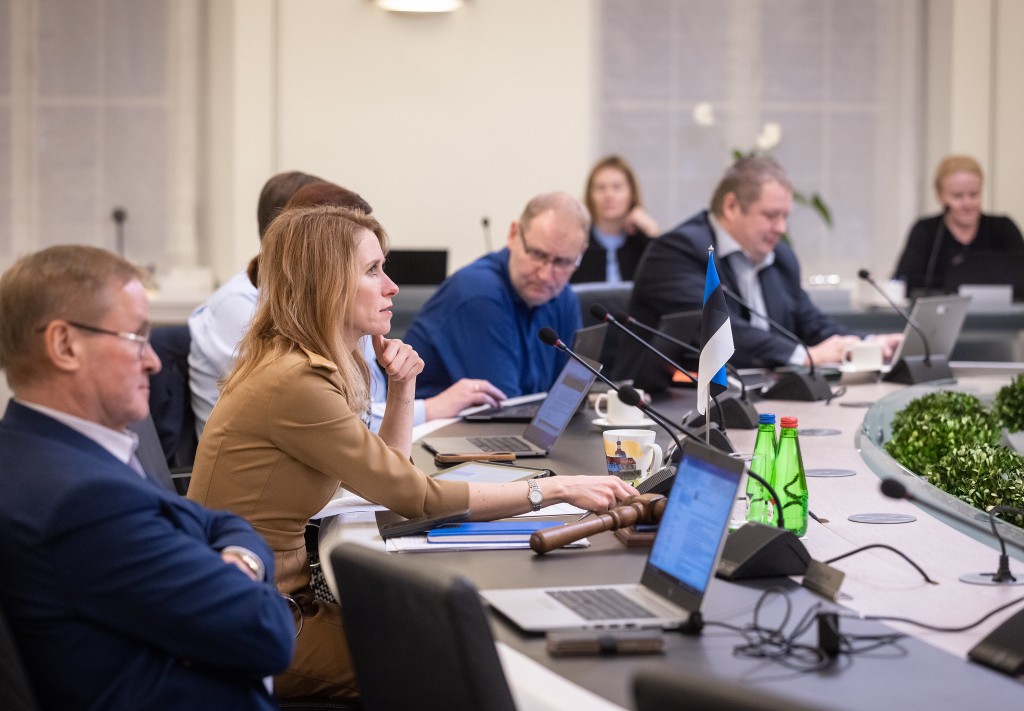
“Russia gathering its forces on the Ukrainian border and taking aggressive action against the safety and security of all of Europe demands us to thoroughly prepare for the crisis brought on by the increase of military action,” said Prime Minister Kaja Kallas.
The prime minister emphasises that alongside allied relations, the basis of Estonia’s security is an independent defence capability and an extensive national defence. “As a society, we must be prepared for a surge of war refugees, a deepening energy crisis, cyber-attacks, as well as a wider economic and social impact. The government has a plan to increase the state’s readiness and handle such situations. Members of government introduced their field-specific actions. In doing so, we mapped out shortcomings which require further contemplation and further action,” said Kallas.
Minister of Foreign Affairs Eva-Maria Liimets acknowledged that in such a turbulent time for the security policy, the main task of the Ministry of Foreign Affairs is to keep in close contact with allies, be ready to support Estonian citizens in Ukraine, and be active in international organisations. “The Ministry of Foreign Affairs prioritises dedicating itself to preventing any sort of escalation, although we are prepared to help Ukraine and our citizens in any sort of development,” Liimets commented.
Minister of Defence Kalle Laanet disclosed that Estonia will continue to work towards its goals related to military national defence and defence policy, which will be accelerated by the government’s recent agreement to allocate an additional 380 million euros to strengthen our security. “Collective defence works and today, Estonia’s independent defence capability is fully integrated into NATO’s solution,” he admitted. By Laanet’s account, a busy period of military exercises in the domains of land, air, and sea forces awaits. “In the context of military exercises, the highlight of the year in Estonia will be the exercise SIIL2022. We all have our part to play in the state’s defence – each little bit counts in military state defence.”
Minister of the Interior Kristian Jaani states that the situation in Estonia and on its external borders is peaceful, although we must always be prepared for anything. “We often find ourselves in difficult predicaments unexpectedly, but we must remain united,” the minister said. “In these kinds of situations, the organisations of the state, local governments, and the private sector must all prepare, and of course, each individual’s preparedness is also necessary,” Jaani stated. “What also counts is voluntary contribution – this kind of aid is of high importance, and everyone should put thought into which field they might be able to help out in.”
During times of possible crises, local governments have an especially influential role. “In crisis situations, it is local governments who must locally ensure the availability of primary services and people’s livelihood,” said Minister of Public Administration Jaak Aab. “This is why all ministries and state institutions should discuss their plans in further detail with local governments and practise them in crisis exercises. The process will be coordinated by the Estonian Rescue Board through regional crisis committees. Everyone must know what they should do in a situation of crisis. “
Tensions escalating in Ukraine might affect energy safety, cyber security, and on the economy as a whole. “The task of the Ministry of Economic Affairs and Communications is to prevent and solve the disruptions in the continuity of services and the effect of the crisis to the state’s economy and supply insurance,” said Minister of Economic Affairs and Infrastructure Taavi Aas.
Minister of Entrepreneurship and Information Technology Andres Sutt acknowledged that the threat of military escalation in Ukraine has remarkably worsened the cyber security situation. “The dependence of the Estonian digital society on communication and information systems as well as electronical services is considerable, therefore we must pay closer attention to cyber security.” The minister added that the importance of cyber security has been a topic of conversation for years, and it is now, at the latest, that specific actions must follow that would actually increase the level of security.
“First and foremost, the executives of companies and institutions must take care of the basic security, back-up plans, and crisis preparedness themselves,” said Sutt. According to the minister, the state can be the central authority in solving cyber incidents, but the responsibility of implementing preventative measures and the existence of back-up plans is on the shoulders of the executives of the organisations. The individual can also ensure their safety in the field of cyber security. Everyone who uses Estonia’s e-services should have three ways of identification: an ID-card, Mobile-ID, and Smart-ID.”
In the domain of the Ministry of Rural Affairs, the tension regarding the security situation on the Ukrainian front affects mainly the food industry. The ministry has mapped out possible risks and is actively working towards mitigating them in cooperation with other institutions, organisations representing the industry, as well as directly with companies vital to ensuring food supply. “The impact of the escalation of the crisis in Ukraine might manifest itself in the partial return of the foreign work force to Ukraine as well as in the possible rise in prices of energy carriers, or in temporary problems in ensuring supply,” said Minister of Rural Affairs Urmas Kruuse. “There is no need to excessively stock up on groats and matches – our food industry stands strong and is overall ready for crises – but each person should have a reasonable supply of commodities at home. This helps us be prepared for unprecedented situations, which do not necessarily have to be crises brought on by war.”
The Ministry of Culture gave an overview in which it became apparent that after Russians, Ukrainians are the largest national minority group in Estonia. There are over 12,000 Ukrainian citizens currently living in Estonia and around 30,000 Ukrainians altogether. The number of Ukrainians in Estonia has increased in recent years.
The Ukrainian community in Estonia is strong and their representative organisations has been a trustworthy and positive partner to the state. Minister of Culture Tiit Terik, admitted that this is especially vital in a situation of crisis. “Organisations help to maintain cohesion within the community and exchange reliable information. The Ukrainian Culture Centre in Tallinn has helped Ukraine in crises before. For example, it has provided humanitarian aid, including financial aid, to the Ukrainians who suffered or were wounded due to the military activities in Eastern Ukraine. On its part, the state supports them financially, and this aid will continue.”
The government will meet to discuss the security situations regularly, either every two weeks or as needed.
Recommendations for preparing for the crisis on a personal level as well as guidelines of conduct to deal with possible crises can be found here:
https://www.rescue.ee/et/juhend/soovituslik-haedaolukorra-varu
https://maablogi.wordpress.com/2013/11/12/mida-hadaolukorraks-toidukappi-varuda/

