
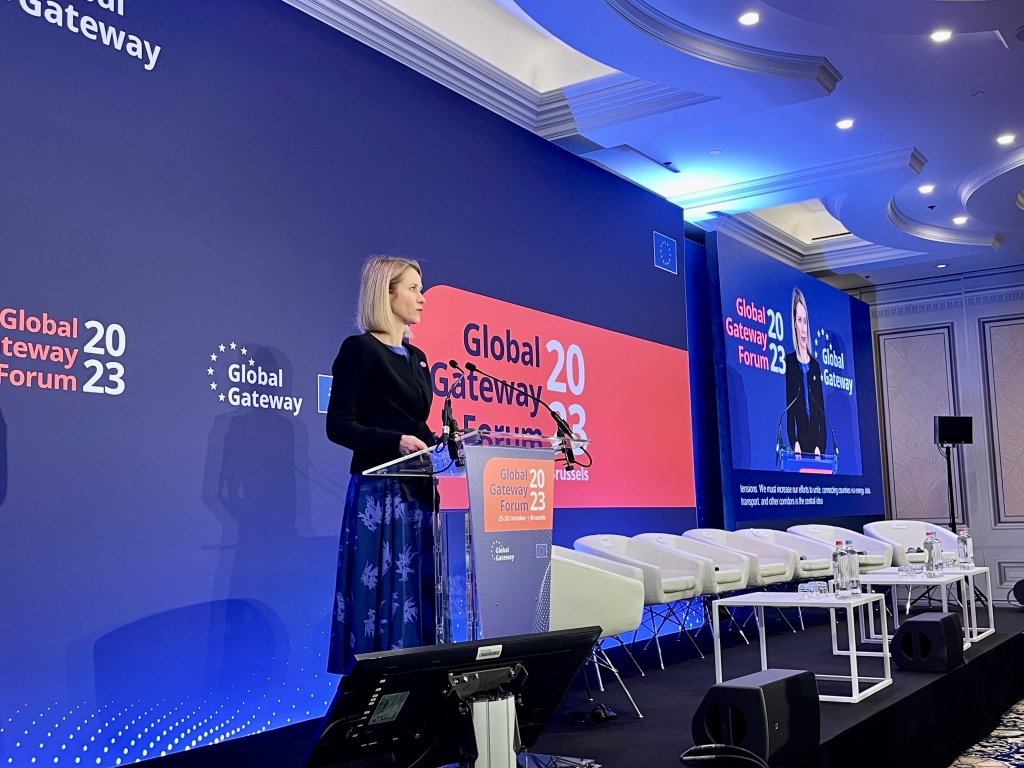
Dear guests,
It is great to be here for this event and I am glad that the European Commission is doing this Global Gateway Forum. Just over a month ago, I had a chance to welcome many of you in Tallinn for the sixth Tallinn Digital Summit. It actually started with the idea of global connectiveness.
In the 21st century, a crucial challenge in the competition for influence really lies in infrastructure and connectivity. We live in a world that is being transformed by digital technology, green transition and regrettably also by mounting geopolitical tensions. To deal with this, we must increase our efforts to unite. And bring in more likeminded and trusted partners. Connecting countries via energy, data, transport, and other corridors is a central idea of the European Union. Doing this also in the rest of the world is what Global Gateway is all about. Joining the efforts of the European Commission and the Member States, acting in Team Europe spirit, is key to having a greater impact.
Mark Leonard, the author of The Age of Unpeace, says in his book that connectivity enables to hurt one another. It might sound harsh at first. But Leonard also says that by acknowledging the risks, we can also overcome this. I could not agree more.
The recent events in the Baltic Sea clearly show how important it is to monitor and protect critical infrastructure. Man-made damage was discovered on the Balticconnector underwater gas pipeline and interruption on two communications cables. This is the second time in just over a year, when critical infrastructure in the EU has been disrupted.
It also stands as a reminder of how crucial diversification really is. The Baltic-Finnish gas market depended on Russian gas monopoly until Russia’s full-scale war against Ukraine. Now, we have replaced Russian gas with trusted sources. We also built new LNG infrastructure. Thanks to this, the Balticconnector gas pipeline damage does not affect the daily life of our citizens. The same goes for the data cables – because of diversification, we have managed to reduce critical dependencies.
But we cannot stop there. In addition to land and sea, the next decade will also bring us challenges from space. We must make sure that our digital societies continue to function in the event of crises. They must be resilient. So, looking at 5G and upcoming 6G networks, safe and transparent technology and diversification of satellite communication capabilities is something we need to think about already now.
Together, we need to further strengthen the resilience of our infrastructure, including digital infrastructure, with the help of efficient monitoring systems, quick response mechanisms and cooperation.
Ladies and gentlemen,
The Global Gateway is our investment in the trusted connectivity together with our partners. We want to build tomorrow’s digital economy by taking into account the needs of every partner. Digital technology is an efficient enabler for democratic and good governance just as we heard minutes ago. It helps to facilitate access to education and healthcare, and boosts economy and green transition.
When Estonia restored its independence in 1991, our country was in a poor state. We set on a long journey of extensive and painful economic reforms. It was supported by the early adoption of electronic identity and the digitalization of government services. Today, 99% of our government services are offered online – ranging from paying taxes and electing the parliament to registering your newborn’s name. Digital transformation has allowed us to achieve much greater transparency and efficiency, and it has given citizens better access to government services. Also, foreign investors and entrepreneurs have found it easy to do business in Estonia.
I am describing our approach because it illustrates a mindset that should form the basis for governance in the 21st century. We should not think of innovation purely in terms of innovative products or transformative technologies. Innovation needs to be put into the service of our own people and democratic governance. Innovation can help to improve the standard of living for everyone while respecting their privacy and rights. A government that is digitally close to its citizens has also allowed us to achieve much greater transparency. I wish that all people benefit from digital transformation and infrastructure.
The Global Gateway gives smaller states, like mine, an opportunity to contribute, to cooperate and amplify where it matters the most. Estonia’s e-governance model allows us to call ourselves the world’s first digitally transformed state. We Estonians are sincerely happy to be a catalyst for change in our partner countries and to offer the possibility to learn from our experience. Thus, Digital for Development is an excellent platform for creating synergies within Team Europe as well as with partners around the globe.
Ladies and gentlemen,
Estonia is participating in numerous Global Gateway flagship projects in Africa, Central Asia, the Caucasus and elsewhere. We contribute to digital infrastructure and the e-services sector within larger projects.
Based on our own experience, my country believes in and promotes open source, reusable and human-centric solutions. The creation of the Estonian digital identity system in 2002 has been one of the most significant digital infrastructure projects in Estonia. It triggered the development and uptake of e-services accessible for all Estonians.
As a result, our administrative burden decreased significantly. At the same time, there are still millions of people globally who do not have any official proof of their identity. Thus, we must all work together, through trusted partnerships, to change that with the help of digital solutions. To give people access to government services and benefits.
Or another example: together with Germany, the International Telecommunications Union and Digital Impact Alliance, the GovStack initiative was created. This is an open-source community establishing global standards for the digitalization of public sector infrastructure. GovStack makes it easier, faster, and more reliable for national, municipal, or local governments to implement secure digital government services. Technological openness is an asset in its own right.
An important part of digitalization and online connections is that one must always be aware of cybersecurity. Criminality exists in the physical world. Malign actors exist online too. Estonia has experienced cybercrime many times since 2007. Our lesson is that the development of digital infrastructure must go hand in hand with ensuring cybersecurity.
Given the more prominent and indiscriminate cyberattacks, it is evident that cybersecurity needs to be set as the cornerstone of the digital transformation ahead. We have to embrace a new way of thinking by adopting trust by design principle on a larger scale: it has to be implemented into our strategies, operating models and our products and services.
Estonia nearly doubled its annual cybersecurity budget last year. This is also why we have been actively supporting the establishment of cybersecurity ecosystems in various countries for over a decade. For example, through the EU Cybernet Initiative, Estonia helped to establish a regional cybersecurity competence center in the Dominican Republic.
A key ingredient of trusted connectivity is resilience. Cyber warfare is being integrated into regular warfare as an established practice. In Ukraine, Russian cyberattacks – though largely unsuccessful – preceded the so-called conventional war. The perpetrator has continued to target data centers and communications infrastructure. We need to adapt to the rapidly changing security environment.
Dear colleagues,
The strength of our market economy-based democracy is the private sector. Estonia’s digital transformation could not have happened without a close relationship and partnership between the public and the private sector. Pooling our resources and expertise with the private sector is also key to delivering the objectives of the Global Gateway. 90% of European companies are small and medium sized. Thus, we must work on how to attract SMEs to contribute. This can be done by improving communication on how to engage in activities within large flagship initiatives.
The Commission is shaping the Global Gateway in the same vein, with the private and the public sector working together. The EU and its Member States need sustainable partnerships to broaden the prosperity and security of Europe and our partners. Closer cooperation with the business sector will help us deliver more quickly on the green and digital transitions and boost our economy. We must aim to build a broad coalition of open countries throughout the world. By working together, as trusted partners, we are building a more connected and secure future.
Thank you!

