
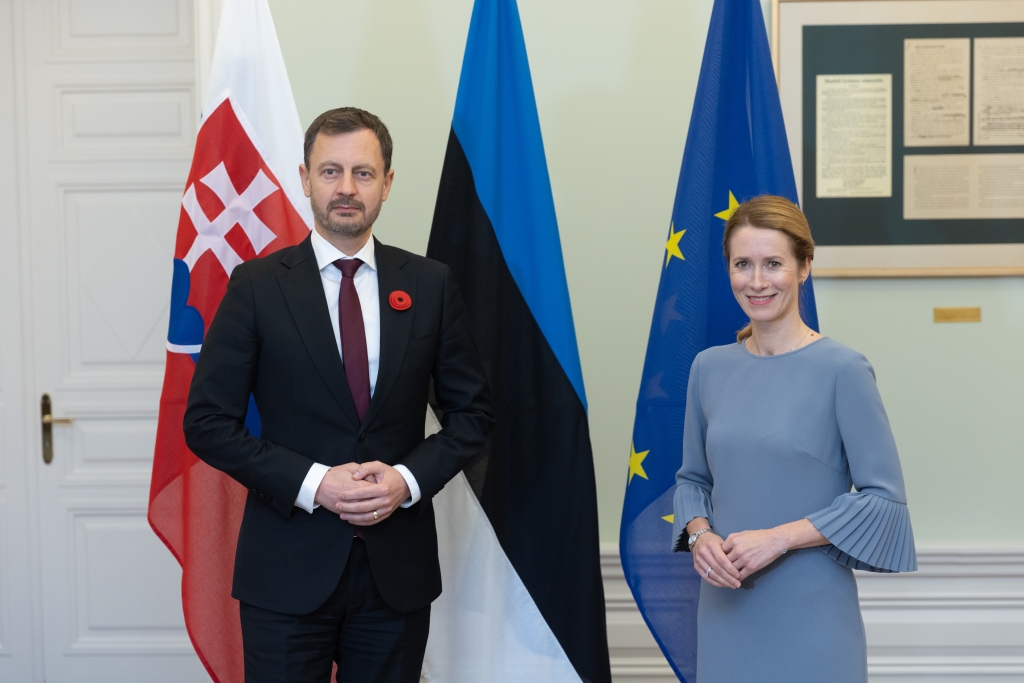
Prime Minister Kallas says that in the course of the meeting her counterpart expressed his interest in cooperation in the field of education. “The general education offered in Estonia is among the best in the world, and we are happy to share our experience,” she said. “Education is a security policy in its own right: it bolsters both democracy and society, and makes the next generation creators of innovation, not just consumers.”
The heads of government agreed that there is potential for cooperation between Estonia and Slovakia in other fields as well: the digital economy, e-governance and cyber matters. “We talked at length about online elections, and I spoke of our experience in conducting them,” Prime Minister Kallas said. “Since people’s lives are becoming increasingly digital, it is important that the state keeps pace.”
The head of government says that Estonia and Slovakia are agreed on the seriousness of the current security situation. “Slovakia borders Ukraine, and we border Russia,” she noted. “The Russians are not waging war solely against the Ukrainians on the ground, but are engaging in a hybrid war, an energy war and an information war. Prime Minister Heger and I discussed what we can do to support our people in coping with the high energy prices and overall rise in the cost of living resulting from Russia’s aggression. It is vital that we come up with common solutions at the EU level. We saw the market respond positively when political agreement was reached between EU leaders back in October. Now it is important that we reach consensus, as soon as we can, on the proposals put forward by the European Commission.”
Speaking of the situation in Ukraine, Prime Minister Kallas remarked that Russia was failing to achieve its objectives on the battlefield, unlike Ukraine, which was recording significant breakthroughs. “The Ukrainians have made very skilled use of the military assistance they have been provided with, demonstrating that with continued support they can win this war,” she said. “They are also capable fighters in winter conditions and will not be fazed by cold weather. We are seeing Russia scrambling to regroup while simultaneously targeting ordinary Ukrainian citizens in an attempt to deprive them of water and power for the coming winter. All of this is designed to pressure Ukraine into negotiating. It is important in the EU to find a way within law to make Russia pay for every bridge, apartment building and power station it has destroyed.”
Prime Minister Kallas added that Slovakia is like Estonia in two key respects with regard to Ukraine: it has been one of the biggest per-capita providers of assistance to the country; and it was among the first to grasp the need to extend military assistance to the Ukrainians. “I call on countries to continue sending arms to Ukraine, especially for air defence,” she said. “It is the path to peace. I also welcome the European Commission’s proposal to grant Ukraine 18 billion euros in support in the new year, because as with military assistance, the Ukrainians need a great deal of financial aid if they are to win the war.”
The head of government also mentioned the cooperation that Estonia and Slovakia enjoy within NATO. “I am gratified to see allies like Slovakia also boosting their defence spending,” she said. “Estonia’s defence budget for 2023 will comprise almost 3% of GDP. We are also working to ensure that the decisions made at the NATO summit in Madrid are implemented as soon as possible.”
This was the Slovakian head of government’s first visit to Estonia. In addition to his meeting with Prime Minister Kallas, he will also be meeting with President of the Riigikogu Jüri Ratas and visiting the e-Estonia Briefing Centre.
Prime Minister Kallas’ press statement (in English): https://valitsus.ee/en/news/remarks-prime-minister-kaja-kallas-press-conference-prime-minister-slovak-republic-eduard
Gallery: https://www.flickr.com/photos/stenbockimaja/albums/72177720303594616/with/52492804445/

