
The head of government described the United States as one of Estonia’s most prominent friends and allies. “We will never forget America’s support for our nationhood and sovereignty, including during the Soviet era,” she said. “Our embassy here in Washington is one of our most important foreign representations, and a symbol of the friendship between our two countries. I am delighted that this historical building has been transformed in the way it has, making it, in both form and function, a true piece of Estonia on American soil.”
Prime Minister Kallas noted that the embassy building, which Estonia acquired in the early 1990s, was also the starting point on Estonia’s pathway to NATO membership. “We are very grateful for strong American presence on NATO’s eastern flank, including Estonia, showing that NATO is ready to defend every inch of its territory,” she said.
The head of government added that as an ally, Estonia too has proven itself to be reliable and committed. “We have been investing more than 2% of our GDP in defence for quite some time now, and from next year that figure will be 3%,” she explained. “We stood alongside the USA in Afghanistan and Iraq, and our soldiers are serving together as we speak on operation Inherent Resolve. We also stand shoulder to shoulder in our support for Ukraine, which is fighting to preserve its sovereignty and nationhood and for the entire free world.”
During the opening of the embassy, Prime Minister Kallas stressed that as a small country, Estonia must also be effective at guaranteeing its security, promoting economic relations and defending the interests of its citizens. “All of this is reliant on active diplomacy,” she said. “I wish everyone at the embassy here in Washington the drive and determination they need to stand up for Estonia’s interests.”
Estonian ambassador to the United States Kristjan Prikk noted that the renovation of the embassy had been a long and complex process. “I would like to thank everyone who contributed to the doors of the embassy reopening to everyone here on Massachusetts Avenue,” he said. “In recent years we have enhanced our cooperation with the USA not only in regard to security and defence, but also in the areas of the economy, cyber issues, development cooperation and the promotion of democracy. And efforts to further relations between our two countries will continue.”
The building which is home to the Estonian embassy at 2131 Massachusetts Avenue NW in Washington, D.C. was built in 1903 and is situated in the city’s embassy district. Estonia purchased the building, which is marked out by its triangular shape and tower, in 1994. It was then remodelled prior to the opening of the embassy in October 1995. The acquisition and reconstruction of the building as a functional embassy was led by then ambassador Toomas Hendrik Ilves, American-Estonian architect Madis Valge and the embassy’s first secretary, Peeter Reštšinski.
In the course of remodelling, the embassy was given a new look by interior architect Rene Safin. Although the building is quintessentially American in its outward appearance, inside it is dominated by clean lines and a sense of openness typical of Northern Europe. Visitors are greeted in the foyer by a white feature wall bearing the word Eesti which recalls a flag waving in the wind. The public area of the embassy is marked out by expansive white wall spaces and glass surfaces embellished with copper details. In both its form and colour palette, the interior employs softer nuances typical of the country it is representing. The dark furnishings, made in Estonia, serve as an elegant, stylish and high-quality accent. The ceiling in the main hall is studded with light fixtures reminiscent of snowflakes which provide a uniform background glow. The white chairs in this room are marked out by their fine lines, which help to maintain a sense of lightness in the space even when it is full of people. The consular reception area on the basement level avoids excessive austerity, while the service area, with separate street access and a disabled lift, provides a warm welcome. The embassy is adorned with seven artworks made for the newly renovated building by Estonian artists Eve Ermann, Pille Ernesaks, Laurentsius, Oliver Soomets and Marje Üksine and Estonian-based Finnish painter Jenny Grönholm. The works were selected as part of a public competition in 2021.
The building was designed by the US architectural firm Quinn Evans. The lead on the project was architect Steven Spurlock, who worked closely with Estonian interior designer Rene Safin from ARS Projekt OÜ. The contractor was Forrester Construction. The success of the renovations was due in large part to the unwavering dedication of project manager Michael Barnhart and site manager William Sloat. The Estonian head of the project and the country’s representative in the construction process was Tiit Kerem, with an important role being played by Katrin Kapanen from the Ministry of Foreign Affairs. The Estonian companies involved in the renovations were Retlar OÜ, MF Leming OÜ, Sealteck OÜ, Optimus Systems AS, Telegrupp AS, Viking Security AS and AS Ecomatics.
Gallery: https://www.flickr.com/photos/stenbockimaja/albums/72177720312683794
Prime Minister Kallas opened renovated Estonian embassy in Washington
15.11.2023 | 14:38
Gallery
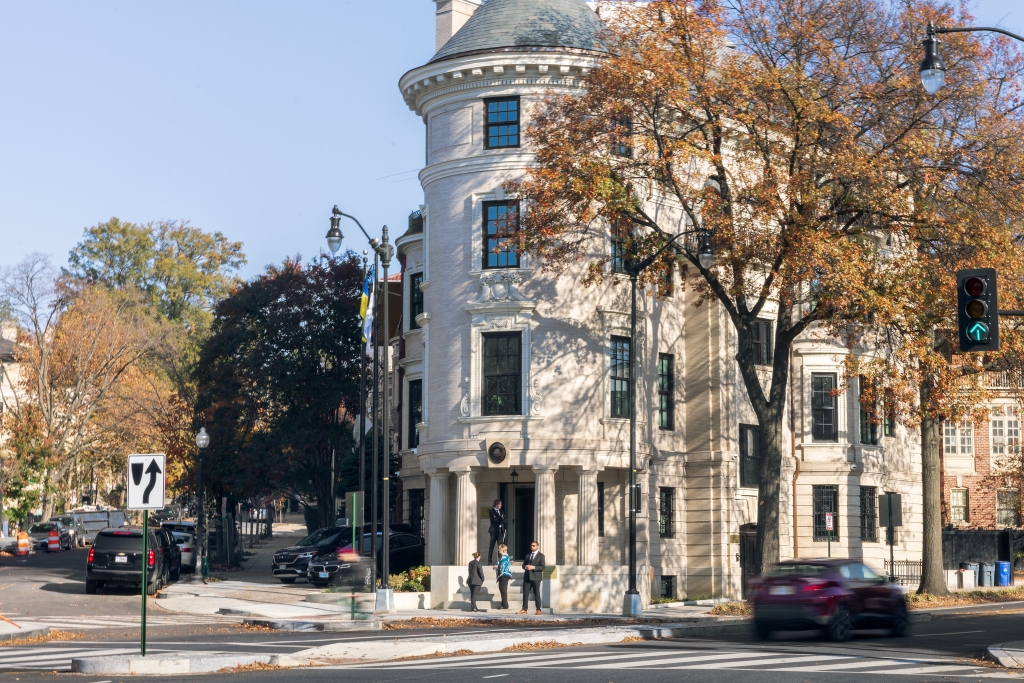
Stenbock House, 15 November 2023 – Prime Minister Kaja Kallas was joined by US Assistant Secretary of State for European and Eurasian Affairs Jim O’Brien in opening the newly renovated Estonian embassy in Washington on Tuesday evening, 14 November.

