
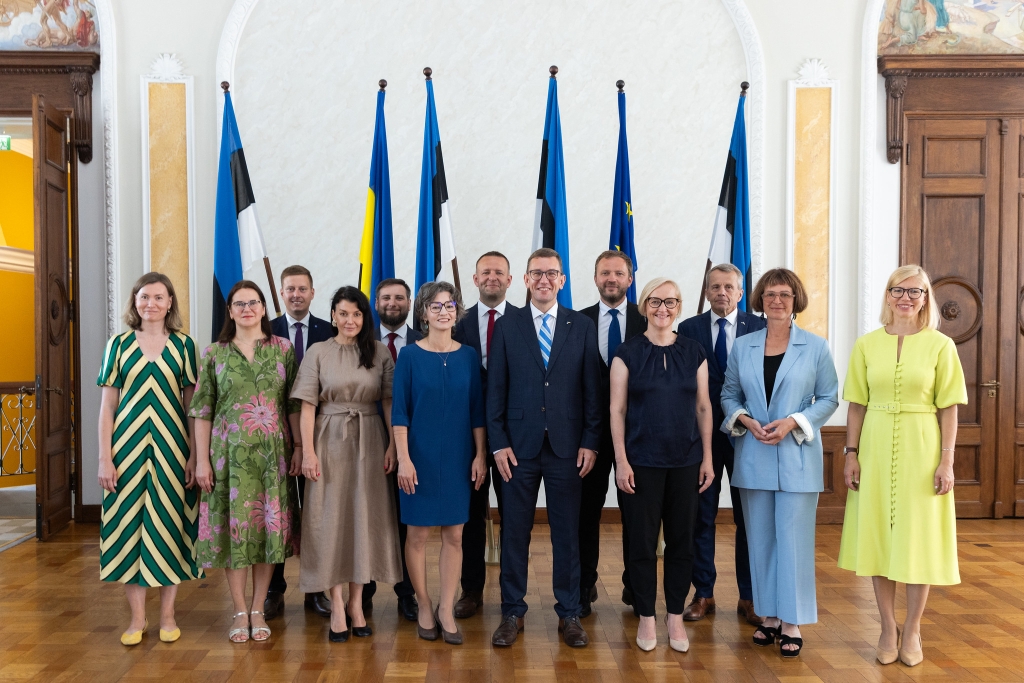
The prime minister stressed that the priority of this government is to secure Estonia’s security and to boost the economy. “Over the next four years, we want to allocate 0.25 per cent of the GDP to support Ukraine’s fight for freedom, while also developing Estonia’s defence industry. To make Estonia an attractive place for investments, we want to cut the red tape and shorten the planning process. We want to create opportunities for innovation and technological development,” said Michal. “With these government priorities in mind, we have changed the ministerial portfolios, and we have divided and refined our tasks so that we can reach these objectives more quickly.”
In addition to the management of the Ministry of Justice and Digital Affairs and its area of government, the responsibilities of the minister of justice and digital affairs include the planning and implementation of digital society policy, the organisation and supervision of digital development and cybersecurity, the coordination of the development of state information systems, including central network and information systems, the organisation of telecommunications, the drafting of the Gender Equality and Equal Opportunities Act, and the management of the relevant structural units of the Ministry of Economic Affairs and Communications.
The minister of economy and industry heads the Ministry of Economic Affairs and Communications and its area of government, except for the areas assigned to the minister of justice and digital affairs. In addition, the minister of economy and industry is responsible for foreign trade and the management of the relevant departments of the Ministry of Foreign Affairs. Other tasks include land use policy, the organisation of spatial planning, land and spatial planning tasks, including spatial data and databases, the management of spatial data services, and land valuation activities, land consolidation activities, the direction and implementation of land reform activities, the acquisition of land needed by the state, performing the tasks of the administrator of state assets in relation to unimproved state land, and the management of the activities of the relevant structural units of the Ministry of Regional Affairs and Agriculture. The Ministry of Economic Affairs and Communications, in coordination with the Ministry of Regional Affairs and Agriculture, decides on the transfer of valuable agricultural land and state land to a local authority.
The minister of infrastructure is responsible for the organisation of the circular economy and waste management policy, housing and construction, transport including haulage, international public transport, transit, logistics, and the transport infrastructure. Other tasks include increasing the international competitiveness of the maritime economy, developing maritime economy sectors and the national fleet, as well as traffic management, planning and implementation of transport systems, mobility, and mobility services, and increasing traffic safety.
The minister of climate heads the Ministry of Climate in the area of their responsibility, except in the areas assigned to the minister of economy and industry or the minister of infrastructure. The minister of climate is responsible for the comprehensive implementation of the green reform, the energy sector, climate policy, and steering businesses towards cleaner technologies. The minister leads the development of renewable energy and coordinates the implementation of renewable energy projects.
The minister is responsible for the environment and nature conservation, as well as for the management of the use, protection, recovery, and accounting of natural resources. Other responsibilities include organising environmental monitoring, meteorological observations, and natural and marine research, organising water protection and use, and policy on the protection and use of the marine environment. The minister also develops policies for the protection of the ambient air and for radiation and nuclear safety and organises environmental monitoring, management of the exploitation of mineral resources, geological mapping, and ensuring national geological expertise.

