
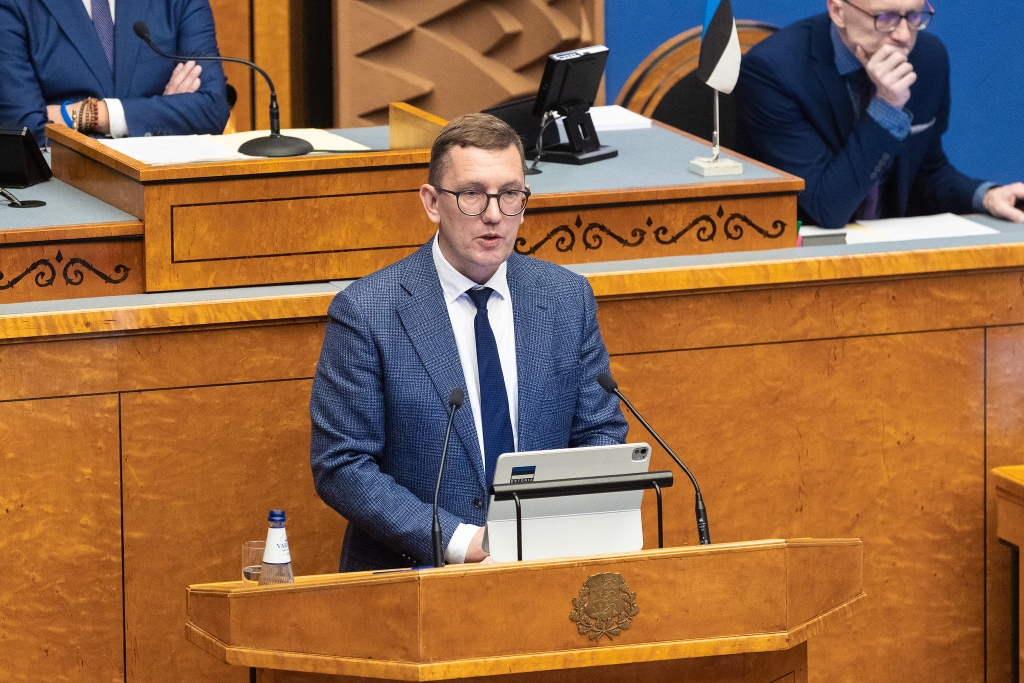
“Membership of the European Union is our firm choice,” said Michal. “Estonia has two major goals in Europe in the coming years – security and restoring the economic competitiveness of Europe. These goals are also closely interlinked. One is not possible without the other,” he explained.
He recalled that Russia’s war against Ukraine has lasted for almost four years. Europe has been one of the biggest supporters of Ukraine, and this must continue. This requires both political and military determination.
Michal emphasised that Estonia wishes to reach an agreement on the use of Russia’s frozen assets before the end of this year. The aim is to provide Ukraine with at least €90 billion as a loan over the next two years, which would only have to be repaid if Russia provides compensation for the war damages and the territorial integrity of Ukraine is restored. The European Commission also made an official proposal last week to use frozen assets.
In order to achieve a just and lasting peace, pressure must be maintained on Russia. The European Union has the means to do so, and we make our own decisions on these matters. “Contrary to Russian propaganda, analyses show that the Russian economy is not doing well either, and boasting about success stories is largely a bluff. Russia has not changed any of its original objectives. It still wants to conquer all of Ukraine and rewrite the security architecture of Europe,” Michal said. “And likewise, we have no reason to ease the pressure on Russia. On the contrary – we have to step on the gas and be brave,” he added.
Michal expressed regret that the EU has not moved quickly enough politically on enlargement issues – the spread of European values is our geopolitical necessity, and Ukraine, Moldova, as well as several other countries have chosen the European path.
The prime minister pointed out that Europe itself has become more united and understands security risks and the importance of defence readiness in the eastern flank better. Russia’s actions in the Baltic Sea region demonstrate the urgent need to develop drone defence and air defence capabilities in Estonia and Europe more broadly. Therefore, Estonia expects support from the EU in the form of joint financing in order to collaboratively produce and procure more quickly and on a larger scale. Even before the next EU budget period, additional resources are needed to protect the eastern border and, more broadly, to fulfil critical capabilities.
The future of the European economy
“We see that global competition is constantly increasing. Trade is characterised by increasingly aggressive behaviour. We must ask ourselves what we can do in Europe to be the first in breakthrough technologies,” said the prime minister. He emphasised the need to exploit the advantages of the single market and channel investment into the European economy, particularly into new research-intensive areas.
Michal pointed out that Estonia is a leader in reducing bureaucracy and developing the internal market in order to promote economic growth. To this end, it has convened a council for economic growth and efficiency, which has already made nearly 700 proposals for reducing unnecessary requirements. Of these, 320 have been approved by the government and 50 proposals have been implemented. Over 60 proposals from Estonian businesses concern the simplification of EU legislation. Seven consolidated proposals have been presented so far under the simplification programme launched by the European Commission.
In addition, the prime minister emphasised the interconnection between climate goals and energy security – abandonment of Russian fossil fuels will help promote green technologies. EU climate policy creates new economic opportunities that contribute to prosperity. The successful disconnection of the Baltic states from the Russian and Belarusian energy systems is also of significant importance in the energy sector. We will continue to cooperate with Latvia and Finland to establish new energy connections. It is important to complete the construction of Rail Baltic with European support.
The prime minister acknowledged that Estonia’s efforts of to convince the European Commission have been successful and that the budget presented to the Member States for negotiation allocates more common funds than before to areas that are important to us – cross-border connections, defence sector, support for Ukraine, and the competitiveness fund. The defence sector, which has so far received only marginal support from the EU budget, would receive a budget five times larger than before – €131 billion.
Read the full text: Prime Minister Kristen Michal’s speech on the political priorities of the European Union, in Riigikogu on 9 December 2025 | Government of the Republic of Estonia

