
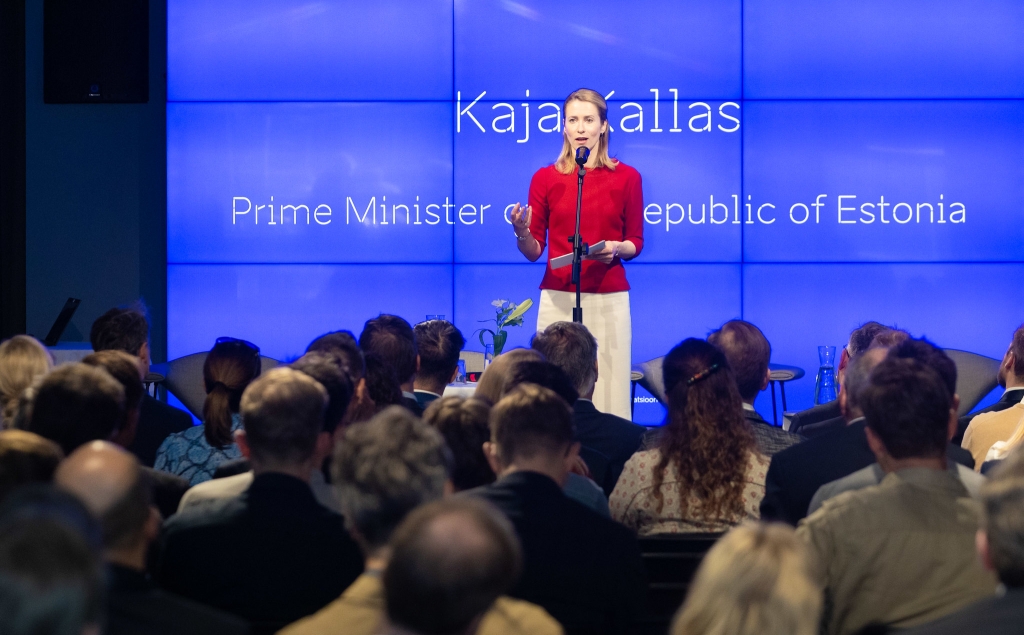
I look forward to today’s discussions. I can’t stay here for all time, but please connect your Estonian colleagues regarding to these interesting topics. As time is short, so we also have time for QA. I will be short and touch some of the issues.
First, as most of you already know, Estonia has come a very long way since 30 years when we regained our independence. We are very proud of all that we have achieved. We don’t think about this every day, but it is a long way, but often in very difficult circumstances. When we emerged from the totalitarian prison 30 years ago, we had to start from zero, or even sub-zero, because the Soviet Union normalised corruption. So, it was okay to steal from the state, because the state was the occupier’s not ours. It required it us complete change or turnaround in mindset that is not okay to steal from the state, because the state is ours and it’s the taxpayers’ money. It also comes to other issues.
When got our freedom back, we realised to build up your economy, the fundamental is rule of law, because investors invest into your country when they can trust the legal system. If something goes wrong, you get help and the juridical system is functioning. This is very important. Of course, in this process, we have received a lot of help from our friends in the Nordics and Denmark, were a good example for in building up our country and economy. It’s always good to have good neighbours that you aspire to, because it takes you up.
I could cite a range of economic statistics showing that in many global ranking we are at the very top or near the very top, usually with Denmark and other Nordic countries. However, I’ll give you another example. Just few weeks ago, there was a visit by the King and Queen of Sweden, a state visit to Estonia, and they had very impressive business delegation. The last time the Swedish royal couple was in Estonia was in 1992, so immediately after we had just regained our independence. When I hosted to lunch for their Majesties, it was very interesting to hear their reflections on what they were now observing and what they remember from the past. Being all the time inside the country, you don’t recognise all the developments we have done. This is clearly seen by those who have not been to Estonia for a very long time. Those of you who already invest in our country now, one of the results of this development is a very open, resilient, flexible and dynamic business environment with a strong startup culture.
Second issue is that I sometimes hear concerned questions “Are you afraid in Estonia?” My response is: “Are you afraid?” Because we are exactly in the same position. We are in NATO, you are in NATO. If you’re not afraid, then we’re not afraid. We are in this together. If it wouldn’t be NATO, we would be living through some really dark times right now. But we are in NATO. That’s why the situation is exactly the same as here in Demark. There are no worries of having war on our soil. We have been a member of NATO for almost 20 years. Being part of this most successful defence Alliance in the world’s history ensures the security environment, to do business, to live and to visit. So, we are very grateful for Denmark’s military contribution and other Allies. It works as a deterrence. If you have neighbouring country as very aggressive, pariah state then it works when you have big friends, like in school bullies. We have strong friends.
Third, despite all the many near-term challenges which we have all currently faced and continue to face, we need to continue to focus on longer-term efforts to secure a better future for our citizens and our planet. This includes further action for digitalization, spur innovation, and play a lead role in the green revolution. This is where a vibrant startup culture comes into play.
Estonia does not have old global players like Maersk, Lego or Novo Nordisk from Denmark, but we started anew 30 years ago, we chose to develop a vibrant open economy with advanced digital capabilities. If you have many incumbents on the market, they don’t necessarily like this new business models to emerge, because they don’t necessarily like the change, they like their position. Therefore, all these new models might be radiated out. I think that is actually the answer to question why instead of 41 we are not going upwards but going downwards. This is something we need to keep in mind.
So in Estonia, to day, our flagship companies are unicorns. By our own count, Estonia has generated 10 unicorns and continues to produce the highest number of start-ups per capita in Europe. Despite the decline in investment during the recent global downturn, the Estonian startup sector continues to demonstrate resilience, adaptability, and growth. In 2022, it grew by every possible metric, so increasing its headcount and revenues. Two new unicorns were born at the beginning of this year and Estonian startups continue to attract money from major global funds active in the region. In 2022, funding deals had a growth rate of about 40% compared to the previous year.
The start-up and especially tech ecosystem is facing similar challenges globally everywhere. One is how to attract more talent and investments while not moving headquarters. To compete on a global market, our talent pool must also be globally attractive and our regional value proposition should be very loud and clear.
Much has already been done. The Estonian and Danish markets have evolved in similar ways, including high rankings in ease of doing business and education as well as digitalisation and sustainability.
But in the startup and tech ecosystem, there is global competition. In terms of global competition, we all separately are too small to attract money from outside. We are too small to go alone, but the Nordic-Baltic region together has a population of 33 million and generates around 2% of global GDP. By working smartly together, we can develop a private equity and venture capital ecosystem which is both sizeable and agile, and thus attractive to large investors in third markets. Putting assets together could also create more sizeable tickets from large institutional players. In other words, instead of competing, we can build a new Silicon Valley – let’s call it the New Nordic Tech Valley.
When I was the Member of the European Parliament, I saw very clearly that – I was working actually with the tech and digital issues, foreign policy and security was not my issue at all – all the aspect where it came to new business models and tech innovation, the Nordics and Baltics had very similar view of let’s-go-faster, whereas there were other doubts in other countries. I think this our strength and we should use this strength to build something, so that we can be competitive as region in the global market.
Some green shoots are already visible. For example, the collaboration between the Nordic Asian Venture Alliance (NAVA) and Copenhagen Capacity, together with Estonian startups and VC funds, has successfully raised awareness of Estonia's startup ecosystem in Asia. Together we can attract talent, we can become regional player and have regional value proposition.
We also have other lessons to learn from Denmark. I am looking forward to visit today to the Technical University of Denmark and its innovation centre Skylab to see how Denmark is fostering innovative scientific solutions and entrepreneurship by creating successful startup ecosystems surrounding academia involving key players, investors, companies and the state sector.
Looking at the esteemed guests in this room, I am confident that good initiatives will follow from the connections made here today. Thank you once again for hosting us and for your presence, and let’s have a good discussion. I going to have with the Prime Minister of Denmark later, and I am going to discuss with her what I said – Prime Ministers job is very difficult and usually every sector of economy comes to you with their demands. And I must say that in my experience only positive cooperation with startup sector.
Thank you and let’s have a good discussion!

