
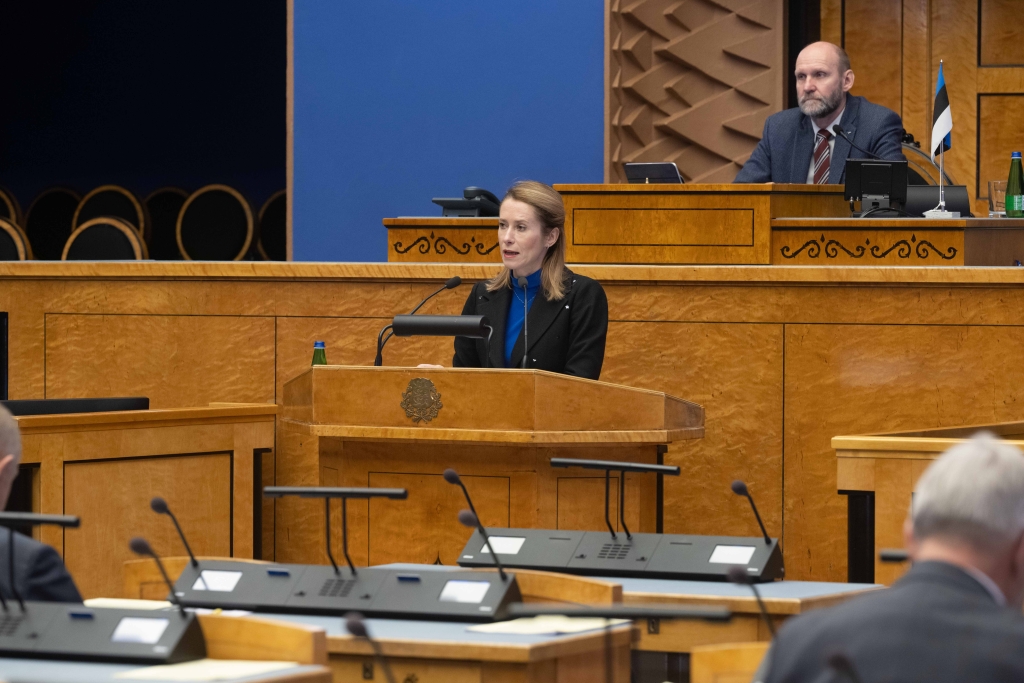
The 24th of February of this year will forever unite the aspirations of the Estonian and Ukrainian people for freedom and independence. The anniversary is also the darkest hour of our generation, when not only the Ukrainian War of Independence began, but we saw the beginning of the full-scale war for a rule-based world order and for Europe. For us, this dangerous flailing of a fading empire is part of history that is trying to keep going. What we are actually seeing is the final act of the disintegration of the Soviet Union. Vladimir Putin has described the disintegration of the Soviet Union as the greatest geopolitical catastrophe. If so, with his attack on Ukraine, Putin will bring this so-called catastrophe to fruition. And not for Ukraine, not for Europe, but for Russia itself. On February 24, Russia signed itself out of the civilized world.
Before February, it was naively thought that the era of empires and colonial conquests had remained permanently in Europe´s past, and that the era of peace had arrived. It was at this point that Western and Eastern Europe's assessments of Russia diverged before the war. Not anymore, it has now been realised that Russia is the most serious threat to peace and to our existence. Russia's aggression and massive war crimes against the Ukrainian people have triggered a number of issues that the Russian leadership did not take into account before 24 February. Russia has lost their friends and respect in the eyes of the world. Russia will never again be a reliable partner in the eyes of the rest of the world. Never again.
Estonia, together with the other allies of the Eastern flank of Europe, has been at the forefront of Ukraine's support and international resistance, both in our statements and with personal examples and steadfastness. We don't know exactly how and when this war will end, but we do know how it won't – it won't end with Russia winning. From now on, as a lesson from the Second World War and from our own experience, the issue of responsibility is also extremely important. Without legal judgment and accountability, there is no hope of a just and lasting peace. Russia must make reparation for the damage caused to Ukraine; war crimes and crimes of aggression must be punished.
We must therefore emphasise even more the importance of the fundamental principles of the international order in countries and organisations that are far from war and do not feel the danger so keenly. The most important thing, however, has been the courageous resistance and unwavering will of the Ukrainian state and people. The most important task of the entire international community is to maintain this determination.
Dear Riigikogu
24 February 2022 This attack was the most important turning point of our era for Europe. I honestly admit that I have never felt so European, I have never been so proud of Europe as I am of the reaction and unity that Europe has shown regarding Russia's aggression. The unity and solidarity of the European Union, as well as its leadership, have been key to mobilising the entire Western world against Russia.
Already on 24 February, we decided to sanction the entire elite of the Russian state and impose unprecedented economic sanctions to stop the Russian war machine. At the Versailles Summit in March, we made fundamental decisions to abandon Russian energy and to move more vigorously towards phasing out fossil fuels and to use renewable energy. We also decided together to strengthen European defence and decided, for the first time, to open the European Union's door to Ukraine.
A turning point in the era is also the prospect of European Union membership for Ukraine, Moldova, Georgia, the opening of accession negotiations with North Macedonia and Albania and we hope to see a decision on the status of the candidate country for Bosnia and Herzegovina soon, as well as the accession of Finland and Sweden to NATO and, hopefully, Schengen membership for Romania, Bulgaria and Croatia. Adherence to these promises is now becoming more and more important in time, as the impact and meaning of these decisions grows with each passing day.
None of these decisions would have come about so quickly if it hadn't been for the war. War requires a quick decision, war requires bold and forward-looking decisions. This, too, is an aspect that Putin's Russia did not take into account. Russia wanted to subjugate Ukraine and crush European unity. In return, he got a stronger and more united Europe than ever before. In return he is facing the world that doesn't love Russia. Some are afraid, some take advantage of Russia, but no one thinks well of them.
Dear Riigikogu
As a result of this war, the world has entered an era where crises are a new normal. It is to be feared that it will take quite a few years before the world can once again enter its regular order. Estonia has been on the right track, assuming that conflicts are comprehensive in nature. The energy crisis and unprecedented inflation, the pressure on borders and migration crises around Europe, the Ukrainian war refugees fleeing the Russian war, the attacks internally and against information and cyberspace, and the support for extremism and instability, as well as the exploitation of other vulnerabilities, are all associated with one reason and one factor - Russian imperialism and the Russian war machine. Unfortunately, however, Russia can only be changed by the Russian people themselves, and today we have no reason to believe that this could happen in the foreseeable future. I do not know if, and when, the time will come when the Russian people will ask themselves and their leaders: why did we need this war? Does Russia lack land, lack natural resources, or what on earth did they expect to achieve with this aggression? Only the Russians themselves can answer that; we can only be better prepared while they seek the answer and those responsible for this. We have to be prepared, then we'll be also less vulnerable.
That is why many decisions are extraordinary and happen for the first time. For the first time in its history, the European Union has funded military aid through the European Peace Facility, and discussions are already under way on how to proceed. The European Peace Facility has also made a remarkable contribution to compensating for and replacing the military resources allocated. The compensation received by Estonia so far is 150 million. We will soon reach agreement on the first joint instrument on the production and acquisition of ammunition, which I called for to be launched urgently at the Versailles Summit. We expect the European Commission to soon launch a medium-term military capability development initiative to consolidate the European military industry, to develop key capabilities in a unified way and to ensure that additional resources for defence serve common defence as much as possible. In cyber defence, we expect a methodology for evaluating cyber investments, based on which we can set a business continuity target for ICT investments. At the end of the year, for the first time in history, a military training mission within the European Union will start to support the Ukrainian Defence Forces.
The solutions to each subsequent crisis we build on the lessons of previous crises. The crisis mechanism, hardened by the European Union health crisis, has helped both Ukraine and the Member States with all kinds of assistance needs. The first launch of temporary protection enabled a unified and solidarity-based response to the unprecedented influx of war refugees. And although 40,000 war refugees have seriously tested Estonia's absorption capacity, without temporary protection there would already be over 100,000 Ukrainian war refugees in Estonia today. This is real solidarity on the part of the European Union. In addition to military assistance, the European Union has provided EUR 7.2 billion in macro-financial assistance to Ukraine and we are on the point of providing even more by 2023. For the first time in history, we will use our unified lending capacity to provide Ukraine with support for survival but also for essential reconstruction. In addition, the use of frozen assets of the Russian State and oligarchs for the benefit of Ukraine should complement this assistance in order to compensate for the damage caused to Ukraine.
Dear Riigikogu
Over the past year, Europe has painfully understood that energy is part of security and that energy connections are, on the one hand, a great opportunity for us, but at the same time, through connections, we are vulnerable. This vulnerability particularly affects energy connections with Russia. In the case of Russia, no one can ever be sure if that connection will be used to deliver energy or an ultimatum. The transition in Europe therefore also concerns the transition in energy production, storage and consumption. I have said before in this room that climate policy is, by its very nature, a policy for the rational use of natural resources and energy. Today's price increase is largely due to high energy and food prices, which in turn have been brought about by the war in Russia. The abandonment of Russian fossil fuels has therefore been too slow rather than too fast. Instead of developing renewable energy, betting on cheap Russian energy was wrong and cost us dearly. Fortunately, to date, these gas pipelines have not become the straw that breaks the back of Ukraine and Europe. Europe is ready for the winter, and quite close to the goal agreed in Versailles of completely getting rid of Russian gas.
I commend the Riigikogu for its courageous decision to raise Estonia's renewable electricity ambition to one hundred per cent of consumption by 2030. Part of Europe's adaptation is the transformation of the energy market to increase the share of renewable energy and accelerate projects. In the Government, we decided to submit amendments to the Electricity Market Act, which is already pending before the Riigikogu. We are removing obstacles to existing projects and, above all, we intend to speed up projects at the development stage. In the 2030 perspective, however, with the participation of the prime ministers of the region and the President of the European Commission, we decided to increase the volume of offshore wind energy in the Baltic Sea by seven times. In August, the Estonian-Latvian joint offshore wind farm project ELWIND was also added to the list of European Projects of Common Interest and we are working to get Estlink 3 on the list to solve the external connections that are today bottlenecks with Finland. In order to accelerate new capacities, we will also carry out a survey of Estonia's preferred wind park areas in two years. At the same time, we believe that the opportunities arising from the RePower initiatives must also be available for existing projects.
The good news, therefore, is that economic prosperity can be decoupled from fossil fuels, and renewable energy is also a viable source of energy. The new green investment classification will enable sustainable investments to be accelerated. Decisions on the accounting of nature capital, on the sustainability of supply chains and on the responsibility of company managers also complement this. The decisions taken provide investment security for an energy transition and better consideration of nature in economic decision-making. This will finally enable energy intensive industry to abandon the "burnt land tactic" of burning oil shale, peat, forest and circular waste. Instead of making large scale investments in natural gas, we should be investing in renewable energy and in the use of bio- and synthetic gases.
Ladies and Gentlemen,
In the midst of crises requiring an immediate response, we cannot lose sight of the longer term either. We need to change what we do so that our children and grandchildren can also enjoy a healthy environment and climate.
At the United Nations, we have set ourselves the goal of controlling global warming and preventing catastrophe scenarios by 2050. I would remind you here of what the former Secretary-General of the United Nations, Dag Hammarskjöld, said, namely that the aim of the United Nations is not to lead mankind into heaven, but to rescue it from hell. The challenge of stopping the warming of the planet while remaining within the natural limits of the planet rests to a large extent on the shoulders of developed industrialized nations.
We have reached the end of the negotiations on the European Union's Fit for 55 climate agreement. A remarkable agreement has now been reached that the last new car with an internal combustion engine will be sold in Europe in 2035. Transportation, agriculture, waste, buildings are our concern at the moment, because we are currently on a path of 13% reduction in emissions, but the target is 24%. Failure to do so could amount to EUR 225 million per year in commitments to the national budget for the acquisition of additional emission allocations.
In recent years, we have also reached a difficult stage in the forestry and land use sector, as the sector has already become a carbon emitter instead of carbon sequestration. Despite intensive negotiations, we achieved a number of flexibilities and compensation opportunities for Estonia, on which to build a further action plan. Irrespective of the flexibilities achieved, however, it is quite clear that the old way will not take us forward. Instead of exporting wood and fuel, the sector's focus must be on increasing carbon storage and added value. After all, we want Estonian nature and Estonian forests to survive, so we have to choose how we can better add value to the wood from our forests and make wooden products that also store carbon, be it furniture or wooden houses.
Discussions are also coming to a close in the area of industrial and energy emissions trading, which is the only sector to date that has reduced emissions. We have succeeded here in protecting the maintenance of free allocations, which is important for the oil shale sector. We have also been able to agree on a more effective carbon price control mechanism. In the future, it will be possible to intervene automatically and quickly on the market in the event of too steep a carbon price increase in order to stabilise the price, and ultimately to ensure a smoother transition and a more predictable carbon price for companies. Equal competition with third countries should, however, be ensured in the future by a new carbon border adjustment mechanism.
With regard to climate and energy policy, the government already has a concrete action plan to accelerate the deployment of renewable energy. With the support of the work of the expert group, the Government Green Policy Committee has reached the final stages of evaluating various areas, mapping measures and preparing the action plan, but concrete choices and decisions must be made already by the next government and the next Riigikogu. The good news is that Estonia has more than EUR 3 billion of European Union funds directly aimed at climate change. Just over a month ago, the Just Transition Fund for Ida-Virumaa was launched, and I am extremely pleased that Silmet has already announced a major investment in its magnet factory. Estonia will not remain a bystander in the international arena either, as we have just decided that the next major foreign policy goal could be the preparation meeting of the UN's major climate meeting, or pre-COP29, which would be held in Estonia in 2024.
Dear Riigikogu
2022 has simply not been just another year and Russian aggression has not simply been another incident. This is a turning point and a year after which the world will no longer be what it was nine months ago. Sooner or later, the war will end, but the wounds from this war will remain for a long time. Aggressors who have wanted to subjugate and destroy other nations have been seen in history before. But they've never gone unpunished. Not this time, either.
President Zelenskyy has expressed his readiness for a just peace. Its content is respect for the territorial integrity and sovereignty of Ukraine in the sense of the UN Charter, securing Ukraine for the future in order to protect itself, restoring and rebuilding, including the use of Russian assets, and prosecuting Russian crimes committed during the war. The European Union and Estonia will support Ukraine fully and for as long as necessary. We should make sure that if we ever look back on today, we will not only remember the great war that began in 2022, but also the time that brought out the best in us and was our finest hour. We are great and generous when we extend a hand to Ukraine in distress, both over here and over there. We are small and petty when we turn our backs on people in need and seek only self-interest in all relationships. We're not going break, we're not going to give up, we're going make it. Because our way of life, our freedom, our well-being and our security depend on it.
Dear Riigikogu,
In my speech today, I was only able to touch on some of the most important aspects of government action in the European Union this year. Inevitably, most of our concerns these days are linked in one way or another to war. I assure you and the Estonian people that we will continue to be good allies to our partners and we will not forget our people. We'll get through these difficult times together. We stand by Ukraine and the Ukrainian people in our thoughts and actions.
Finally, I would like to thank my colleagues and allies, as well as the French and Czech Presidencies of the Council of the Union, who have all worked tirelessly and magnificently in this pivotal year of suffering. I thank the Riigikogu for its active work and confidence. I hope that the next speaker on Estonia and the EU will continue on the path of strong Europe and will not have to start rescuing Estonia alone. If Europe is strong, so is Estonia.
Long live Estonia! Long live Europe! Thank you!

