
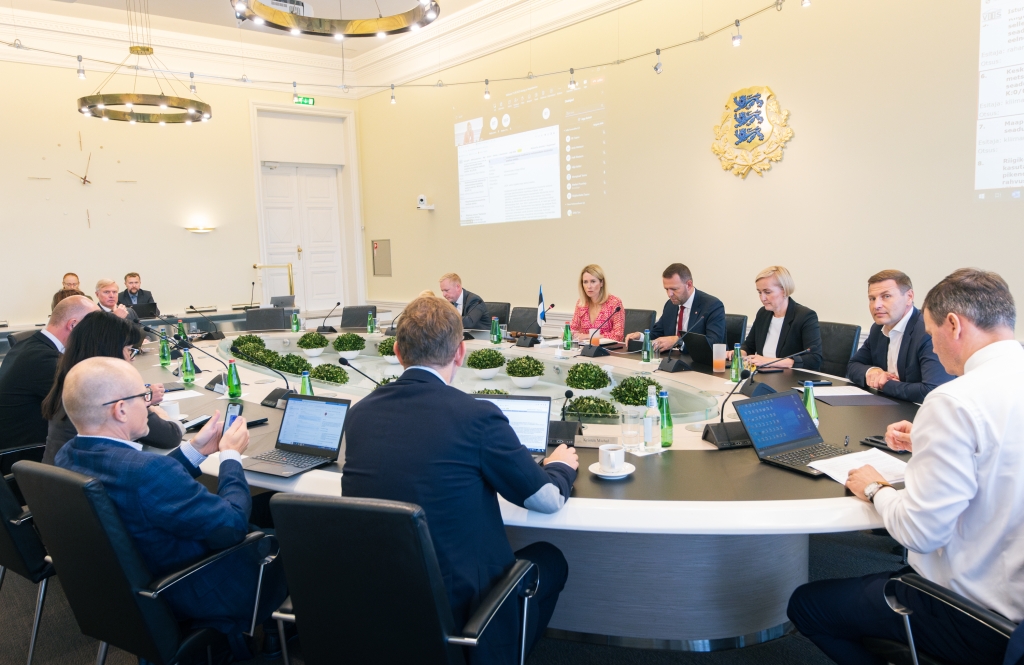
Prime Minister Kaja Kallas says the budget is based around national defence, steps to ensure economic growth and support for Ukraine. “For ordinary people and companies the most striking thing about the budget is no doubt the fact that although we are having to raise VAT by 2%, no new taxes are to be introduced in 2024,” she commented. “What is important at the moment is maintaining and stimulating the economy, which we will be doing through investment. Alongside ensuring security, we will be making as much as 1.7 billion euros in investments next year, and going forward we are planning to invest around 1.5 billion euros annually in order to galvanise the economy and support growth in the country. These investments will be made, for example, in construction and the development of infrastructure, in agriculture, in digital developments and in the implementation of the green reforms. Our aim is to make Estonia a safer, smarter, greener and more knowledge-based place. And needless to say we will continue to support Ukraine.”
The head of government remarked that the nation’s finances are in a poor state and that the most complex challenge for the government was finding a way to reverse this situation. “The decisions made by previous governments to greenlight prohibitive new ongoing costs since 2016 and to take out loans to pay for them means that by next year Estonia’s national debt will reach as much as 21% of GDP,” she said. “That is why every minister this year has had to make some difficult and unpopular decisions, because they were unavoidable. Without them, based on our summer forecast, Estonia would have to pay 480 million euros per year in interest alone in 2027. This is money that could not be used in the interests of Estonian education or the country’s economy or its people: it would solely cover the cost of repaying the interest on the loans.”
Prime Minister Kallas said that her government aims to help Estonia out of this debt spiral. “Too high a loan burden is unsustainable for the country,” she warned. “The money available has, after all, been contributed to the state coffers by Estonian people and entrepreneurs. As a society we must work together to reach a consensus on how to cover the last remaining costs in the budget.”
Minister of Education and Research Kristina Kallas also stressed the importance of getting the nation’s finances in order. “The forecast on the budget position clearly shows that if we carry on at the same pace, then by 2027 government-sector expenditure will significantly exceed revenue,” she explained. “Although the most popular solution to this would be to take out a loan, which the opposition has recommended, that would lead Estonia into a Greek-style debt crisis. No responsible government would do that, so it is imperative that we bring the state’s finances under control. That is part and parcel of any strong economic policy. We have to admit to ourselves that we cannot continue in the same vein, and admit to the people of Estonia that we need to boost our revenue.”
This means having to simultaneously reduce national spending, which Minister Kallas describes as “having gotten out of hand”. Next year will start with zero-base reforms in the course of which 51% of the state budget will come under review: doubling-up will be eliminated and the transition will be made to needs-based support.
Minister Kallas says her party, Estonia 200, considers it important that agreement is reached regarding areas in which savings cannot be made – namely defence spending and investments in education. “Costs need to be reviewed in the field of education as well, because in the case of such a large investment it is simply not true that we remain unable to pay our teachers a decent salary from the budget,” she said.
Minister of the Interior Lauri Läänemets noted that the government was also able to make some positive decisions despite the state of the budget. “For instance, over the next two years we will be channelling 60 million euros into public transport reforms to get buses and trains running more often and to establish a single ticketing system for the entire country,” he said. “Public transport needs to be at a good level in regional areas, too, so that owning a car is not a choice that people are forced into. We also managed to stave off cuts that were hanging over a number of areas – research and education funding for one, and there will be no cuts to police or rescue workers’ salaries either. From the point of view of internal security, it is noteworthy that we have obtained permanent funding for both civil protection and further training for police officers, and that we will be able to build new dormitories for students at the Estonian Academy of Security Sciences.”
Minister of Finance Mart Võrklaev said that the starting point of this year’s budget negotiations was a difficult one. “The budgetary regulations established in the State Budget Act were developed prior to the recent crises and do not meet the actual needs that arise in such times, or in the wake of them,” he explained. “Moreover, the state’s ongoing costs have continued to rise in recent years without additional revenue being generated. We have to bring our budget-balance rules fully into line with EU regulations and drop the stricter rules that Estonia itself has imposed. Budgetary regulations need to be possible for a country to work with and must help improve the state’s finances.”
The structural shortfall in the 2024 budget remains at the same level, i.e. 1.2% of GDP. This is one aspect of the flexibility of EU regulations, in which structural adjustment is not considered vital the following year if the economic situation is very poor in the current year. In subsequent years (starting from 2025) the government plans to maintain this structural position or slightly improve it, to 1% of GDP.
The costs of the Estonian state are growing because of Russia’s war in Ukraine. “To ensure the broad-ranging reinforcement of Estonian security while keeping the state’s finances in order, we will have to raise additional budget revenue equivalent to 1% of GDP over the next four years,” Minister Võrklaev revealed.
Many areas require additional funding: internal security; civil protection; wide-ranging national defence and ICT investments; defence against a variety of hybrid threats, cyberattacks and subversive leverage; reinforcement of Estonia’s information space and the transition to Estonian-language education; guaranteeing vital services (communications, electricity, water and transport connections) and improving security of supply; and boosting continuity of service in health care, social welfare and other critical services.
Minister Võrklaev says the government is seeking to launch a public debate in the coming months on the implementation of a broad-ranging security tax. “We realise that increasing the tax burden to such an extent needs much more time for discussion in society, and that such decisions cannot be reached in a matter of days or weeks,” he conceded. “In any event, no new taxes will be introduced in 2024 beyond those which have already been implemented. We are postponing the car tax as well so that we can find the best possible solution for the country.”
Estonia will continue to support Ukraine so that the beleaguered country is able to cope with the impact of Russia’s aggression: via major international funds and the EU budget, but also directly. The 2024 budget for Estonia earmarks almost 30 million euros in support of Ukraine’s rebuilding, which includes an increase in the EU’s contribution in connection with the planned Ukrainian support fund, humanitarian aid and support for loans issued to Ukraine from both the EU and the European Investment Bank (with lowered interest rates and implementing costs for guarantees). A further 15 million euros in guarantee capacity has been planned for in the budget, as has 1.9 million euros to boost Estonia’s holdings in development banks contributing to Ukraine’s rebuilding.
Also agreed within the framework of the budget strategy was where savings would be made and where additional funding may be sourced in the areas of government of individual ministries. A consolidated overview of savings and revenue measures can be found on the website of the Ministry of Finance.
The state budget strategy for 2024-2027 and the drafts of the 2024 budget are planned to be approved by the government at its session on Tuesday 26 September. This will be followed by a press conference in Stenbock House outlining the numbers that have been agreed on in the budget. Information on the press conference and accreditation for it will be issued on Monday.

