
Dear Secretary Blinken, members of the press,
It is my great pleasure to welcome you here in Tallinn. I have been closely following your work and I admire it greatly. I wish your visit could have been under more pleasant circumstances.
Our discussion today focused on the sharply deteriorated security situation in Europe and the need to adapt to the new reality, raising the cost of aggression for Russia and supporting Ukraine.
Putin’s war against Ukraine is an act of military aggression against an independent and sovereign state that wants to fulfil its own European Dream.
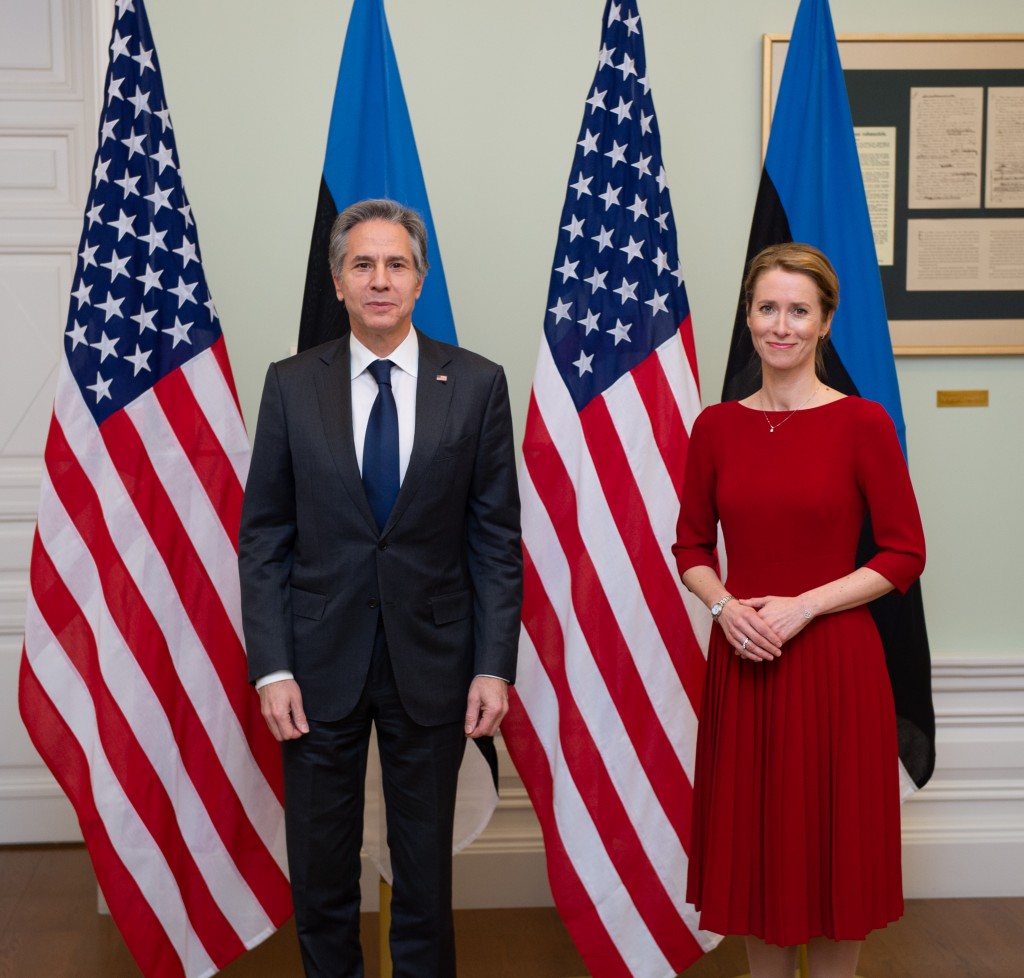
We are standing here in the State’s Elders Room. So, the pictures you see around this room are of our state elders, the politicians who were running the country before the Soviet occupation. It reminds us of how valuable independence and freedom is and it also reminds us that we have a very aggressive neighbour that we have suffered under.
The Kremlin’s war tactic is to terrorise civilians and put them at the frontline of this war. This is brutal and heart-breaking.
This tragedy demands first, our continued and united support to Ukraine – political, humanitarian, economic and military. Second, our focus must be on full isolation of Russia from the free world. Third, we need to adapt our own and NATO´s defence taking into account this new reality.
Ukraine fights bravely for its homeland. What it needs urgently now is our military help. And here the American commitment and help have been and continues to be crucial. Estonia, together with the U.S. was one of the first to give military support to Ukraine before the full-scale war started on the 24th of February.
We should stop the military machine of the aggressor – the democratic world has stepped up against this war with speed, strength and determination. Our unity and action will help tame the aggressor. But we need to be prepared that the worse is still to come. Hence Putin´s violence must be in correlation with further sanctions and isolation decisions:
- We need to finalize and fully close SWIFT for Russia and Belarus.
- Moreover, restricting the use of crypto currencies is equally important.
- We have closed our airspace, now we need to take a step further and close seaports for Russia’s vessels.
And we will keep on finding new tools in our toolbox until Putin’s war machine has been paralysed.
We are in this for the long haul. We see already tremendous policy shifts vis-à-vis Russia across the EU. What we need next is the strategic patience to keep these decisions in place.
Russia expects us to make a step back soon. As Dimitri Medvedev explained to Putin in a recent public meeting of the Russian Security Council and I quote: “Sooner or later they will get tired of their own initiative, they will come to ask us about returning to discussions and negotiations regarding all the matters of strategic security.” End quote. So we will prove them wrong. They will come and test us and yes, we will have to resist.
Our new reality also demands rapid changes to European, including Estonia’s own defence. Estonia has long spent over 2% of its GDP on defence and we continue to call others to do the same. In January my government decided to raise it even more. This means that in 2023, our increased defence budget will be 2.44% of our GDP.
NATO needs to adapt quickly as well. Decisions we have to make in the coming weeks and months need to include an upgraded strategy for defence in our region. This means permanently strengthening our defence on land, in air and at sea. I would like to thank the U.S. for your presence and for quick decisions that led to your increased footprint in the Baltics. We have to keep on working together for the long-term decisions. That is why I also asked today to establish a permanent and meaningful NATO’s forward defense in the Baltic region.
In conclusion, I would like to thank you Secretary Blinken and the U.S. administration for your heavy work including intense consultations in building the unity of Allies and partners. Our unity and scale of our joint decisions prove the strength of our democracies.
Thank you.

