
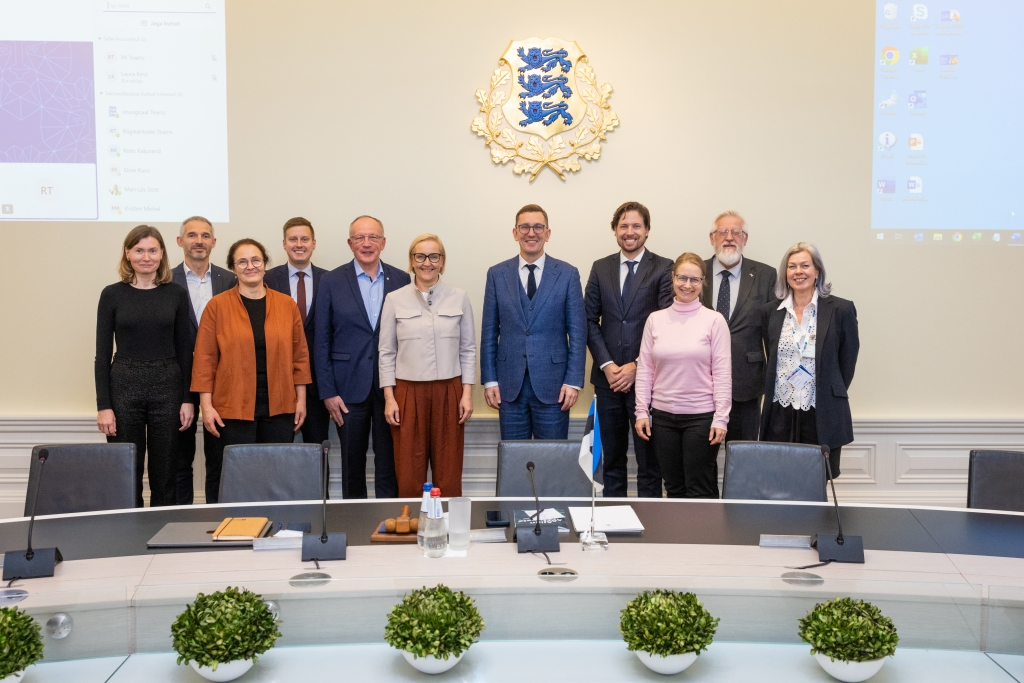
Prime Minister Kristen Michal thanked members of the Research and Development Council for their three years of work. “I thank the members the Research and Development Council for their input on how science can contribute to economic development. The work of these people has given a good impetus to the establishment of the Estonian Centre for Applied Research, which will create direct links between science and business in areas with high development potential.”
The prime minister noted that the government is guided by the concerns of the economy. “The new composition of the Research and Development Council could also focus on finding solutions on how science can further support our businesses and economy and how our people could produce goods with higher added value and for export. This should be the task for the new composition of the Research and Development Council.”
Kristina Kallas, Minister of Education and Research, stressed that the Research and Development Council has been a demanding and important partner for the state, helping to keep the focus on the major challenges facing the country. “It is very important that members of the Research and Development Council have taken on a bigger role in working groups in solving the bottlenecks in research and innovation – be it increasing the research capacity of the private sector, funding higher education, or the next generation of researchers,” said Kallas. “With the support of the Research and Development Council, we are also nearing the end of work on the development of a new organic law in the field, which for the first time will consolidate the organisation of research and innovation by the state into a single comprehensive regulation. While work remains to be done to make the research and development activities of the ministries more strategic, I look forward to a similarly consistent and committed contribution from the new team.”
Among the substantive topics, the Research and Development Council meeting discussed Estonia’s position on the 10th EU framework programme for research and innovation (2028–2034), the world’s largest fund for research programmes. The positions will be further developed in the light of the discussions of the Research and Development Council and submitted to the government for approval.
As at August 2024, Estonia is involved in 459 funded projects, bringing 216.7 million euros to research. This puts Estonia in third place in the ranking of participating countries in terms of GDP and seventh in terms of population. Estonia has excelled in the so-called widening participation actions for countries lagging behind, which have, for example, supported the launch of the UT–TalTech centre for digital bioengineering, the UT personalised medicine research and development centre, and a successful UT project on nanomaterials in extreme environments.
At the Research and Development Council meeting, an overview of the state of development of the draft Organisation of Research, Development and Innovation Act was received. The drafting of the act started already in the summer of 2020 and in 2023 it reached the Riigikogu, but was dropped due to the parliamentary elections.
Work to modernise sectoral regulation has continued in the meantime. The aim of the draft remains to bring the legal regulation of the field in line with changes in society, to take more account of the integrity of the research and development and innovation system and the needs of the private sector. The proposal sets out the legal framework for the implementation of the principles of research ethics and open science.
The Research and Development Council supported the submission of the draft to the meeting of the government and its submission to the Riigikogu for further discussion.
Photos: https://www.flickr.com/photos/stenbockimaja/albums/72177720321567176/with/54102763225

