
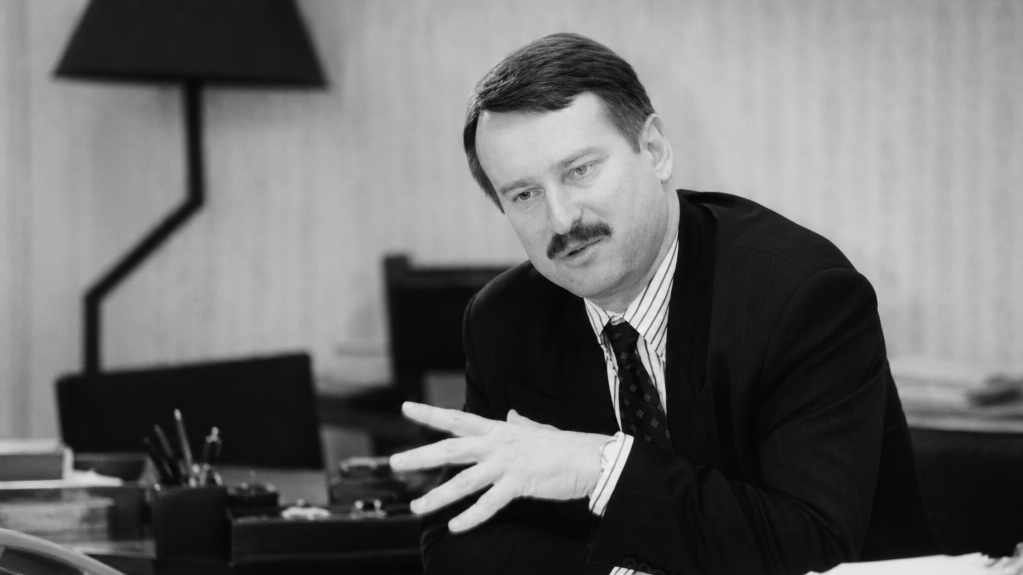
One of the authors of the idea of Estonia’s economic independence
On 26 September 1987, an article by Siim Kallas, Tiit Made, Edgar Savisaar and Mikk Titma, titled “Proposal: The Entire Estonian SSR to Full Self-Management,” was published in the newspaper Edasi. The Isemajandav Eesti, or Self-Managing Estonia (IME), proposal called for Estonia to gain economic autonomy, transition to a market economy, and establish its own monetary and tax systems. The proposal brought into public debate Estonia’s right to make its own economic decisions and increasingly linked economic autonomy with political self-determination. IME also helped pave the way for the restoration of Eesti Pank and preparations for the introduction of Estonia’s own currency.
One of the leaders of the currency reform
Siim Kallas became President of Eesti Pank on 1 October 1991 and served in the position until 1995.
Kallas was a member of the Currency Reform Committee and was authorised to represent Estonia in negotiations with the Bank for International Settlements and with the countries where Eesti Pank’s gold had been deposited before the Second World War. As a result of these negotiations, approximately 11.3 tonnes of gold were returned to Eesti Pank, becoming an important part of the reserves backing the Estonian kroon.
On 20 June 1992, the kroon was reintroduced in Estonia, and the country left the rouble zone. The currency reform was a joint effort involving numerous politicians, economic experts, officials and employees of Eesti Pank. Siim Kallas was one of its key decision-makers and leading figures.
A Shaper of Estonia’s Economic and Political Landscape
In 1994, Siim Kallas was one of the founders of the Estonian Reform Party and became the party’s first chairman. He led the Reform Party for ten years. Kallas was elected to the 8th, 9th, 10th, 14th and 15th convocations of the Riigikogu.
From 1995 to 1996, Siim Kallas served as Minister of Foreign Affairs. During his tenure, Estonia submitted its application to join the European Union and began establishing the national coordination structures needed to prepare for accession.
From 1999 to 2002, Kallas served as Minister of Finance in Mart Laar’s government. During Kallas’s tenure, on 1 January 2000, a new corporate income tax system came into force under which corporate profits are not taxed when earned, but when distributed.
Prime Minister at the Threshold of NATO and European Union Membership
The government led by Siim Kallas took office on 28 January 2002 and remained in office until 10 April 2003. The 42nd Government of the Republic of Estonia was formed by the Reform Party and the Centre Party.
Kallas’s tenure as prime minister was marked by two decisions of major significance for Estonia’s foreign policy. In November 2002, at the NATO Prague Summit, Estonia was invited to begin accession talks with the Alliance. In December of the same year, Estonia concluded its negotiations on joining the European Union.
Estonia’s accession to NATO and the European Union was completed in 2004.
Ten Years as Vice-President of the European Commission
In May 2004, Siim Kallas became the first Estonian to serve as a member of the European Commission. Initially, he was responsible for economic and financial affairs. From November 2004 to 2014, he served as Vice-President of both European Commissions led by José Manuel Barroso. Siim Kallas was a committed European and a strong advocate of close cooperation among European countries and of the European Union.
During his first term, Kallas was responsible for administrative affairs, auditing and the fight against fraud. Under his leadership, greater transparency was brought to the use of European Union funds, decision-making processes and the representation of interests. The beneficiaries of EU funding were made public, and a register of interest representatives was established, along with a code of conduct.
From 2010 to 2014, Siim Kallas served as European Commissioner for Transport and Vice-President of the European Commission. During his tenure, a new framework for the Trans-European Transport Network (TEN-T) was developed, and the relevant legislation was adopted in 2013. Rail Baltica was also included in the Trans-European Transport Network. During Kallas’s tenure, the project’s importance as a railway linking the Baltic states with the rest of Europe was recognised, and decisions were taken that laid the groundwork for its future financing from the European Union budget.
After leaving the European Commission, Siim Kallas stood as a candidate for President of the Republic of Estonia in 2016. From 2017 to 2019, he served as Mayor of Viimsi Municipality, and in 2019 he returned to the Riigikogu. In September 2024, Kallas left the Riigikogu and retired from active politics.
A Devoted Champion of Estonian Culture
Siim Kallas’s interests extended far beyond politics and economics into the realm of culture. He was an avid reader who described himself as a “reading addict”. He read widely in both prose and poetry and named Juhan Viiding, Paul-Eerik Rummo and Betti Alver among his favourite poets.
Kallas had a particular affinity with theatre and music. He was a devoted opera-goer and concertgoer, both in Estonia and at Europe’s major venues. Through the Fund bearing his and his wife Kristi’s names, which they established in 2009, he supported theatrical explorations of Estonian history and its leading figures. Kallas’s cultural interests also extended to the visual arts. He appreciated and collected Estonian art; his home included works by Eduard Wiiralt, and he felt a particular affinity with the work of Kaljo Põllu, Aili Vint and Toomas Vint.
Culture also had a family dimension in Kallas’s life. Through his mother, Rita, he was a member of the Alver family and was related to Betti Alver. Kallas recalled how his mother followed the poet’s work closely and spoke to her children about Betti Alver and Heiti Talvik, and how he himself began reading Alver’s poetry.
***
Siim Kallas graduated from Tallinn Secondary School No. 22 with a gold medal in 1967 and from Tartu State University in 1972, graduating cum laude with a degree in finance and credit. During the Soviet era, he worked at the Ministry of Finance of the Estonian SSR, in the savings bank system, and as deputy editor-in-chief of the newspaper Rahva Hääl. From 1989 to 1991, he served as Chairman of the Estonian Trade Union Confederation and as a People’s Deputy of the Soviet Union.
Kallas wrote extensively on economics, politics, liberalism and the European Union. His books include Turumajandus ehk kodanike riik (The Market Economy: The Citizens’ State), Vabaduse ja kurjuse vahel. Euroopa Liidu lugu (Between Freedom and Evil: The Story of the European Union), Eduard Alver. Tema aeg ja inimesed (Eduard Alver: His Time and His People), Mina. Siim Kallas (I: Siim Kallas), Liberalism: ideed ja poliitika (Liberalism: Ideas and Politics), and Torupill ja nuga. Alverite saaga (Bagpipe and Knife: The Alver Saga).
From 1976 to 1989, he was editor and host of the Estonian Radio quiz programme Mnemoturniir.
Awards
In 2003 Siim Kallas was awarded the Order of the National Coat of Arms, 2nd Class, for services rendered to Estonia, and in 2015, the Order of the National Coat of Arms, 1st Class.
In 2001, Siim Kallas received France's highest honour, the Order of the Legion of Honour (4th Class, or Grand Officer).
In 2000, Kallas was awarded the Order of Merit of the Federal Republic of Germany, and in 2019, the Order of Merit of the Republic of Poland, 3rd Class (Commander's Cross).

