
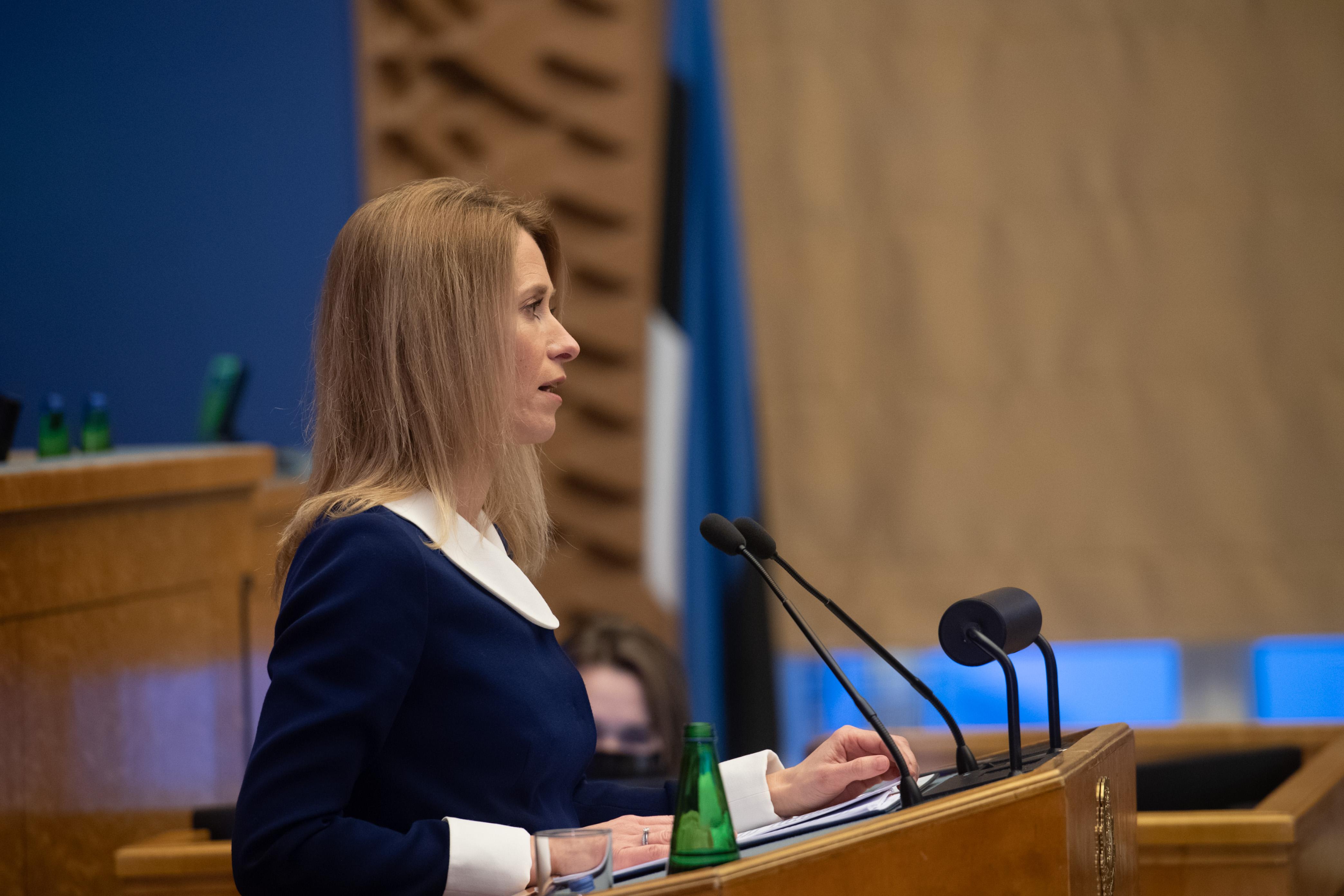
Dear President of the Riigikogu!
Honourable members of the Riigikogu!
Dear people of Estonia!
The new government has been in office for four weeks and, as I said, the main priority for our government is dealing with the coronavirus crisis. Therefore, I am happy to give the honourable Riigikogu an overview of the situation regarding managing the coronavirus pandemic in Estonia.
We have had to live with the virus for almost a year. In many ways, this has meant finding a balance between closing Estonia and keeping the state open, as well as between ensuring the continuity of the medical system and the functioning of society. These are serious decisions that affect all people in Estonia.
I would like us to be able to remain dignified in dealing with the coronavirus crisis. Let us not bring the COVID-19 crisis to the usual battleground of political parties. We should not fight over reaping the maximum political benefit from the crisis. Last spring, during the first wave of the pandemic, the opposition of the Riigikogu did not come close to showing the kind of pugnacity that the current critics of the government are showcasing. These are largely the same people who formed our government a month ago. Those who accuse the new government of easing the restrictions should be reminded that the decision to relax the restrictions was made by the government of the Estonian Centre Party, the Conservative People’s Party of Estonia, and Isamaa on 15 January. When did the new government take office? On 26 January.
What did the new government immediately do? In accordance with the proposal of the scientific council, on 29 January, we decided to harmonise the restrictions all across Estonia. I still believe that harmonisation, which meant much stricter restrictions for most Estonian counties, was justified. I also believe that in Estonia, which is a small and tight-knit country, the distinction made in December was not sufficiently substantiated. It probably provided an additional impetus for the virus to spread to areas which were previously less infected.
The situation with the coronavirus is very serious: the number of infections is still very high and the spread of the virus is extensive. In our society, stress and fatigue are increasing due to limited living arrangements.
However, in the long run, there is reason to be more hopeful than before. At the beginning of this year, we launched the vaccination process, which will allow us to live with the virus so that Estonia remains open.
Dear members of the Riigikogu!
We are still in the middle of an emergency. The government makes its decisions by monitoring a number of indicators, one of the most important of which is the capacity of the hospital network. According to Urmas Sule, the Head of the Emergency Medicine Department of the Health Board, the current capacity of Estonian hospitals to treat COVID-19 patients is 755 beds, of which the intensive care capacity is 67 beds. Out of all infected persons, a total of 7.4% has needed hospital care. There are currently 525 people in the hospital and 26 patients need controlled ventilation.
The numbers are high, but on the plus side, our medical system has been able to treat people in such a way that the number of patients who need controlled ventilation and the mortality of COVID-19 patients has been lower in Estonia. We allocated 621,000 euros from the government reserve for the purchase of Remdesivir, which significantly alleviates the severe course of the disease. In Estonia, 540 cases or 0.9% of COVID-19 cases have been fatal. From this it can be concluded that the testing system is good in Estonia. We find the infected people quickly and their treatment is effective. We express our gratitude to our doctors and medical staff for that.
Honourable Riigikogu!
The rapid spread of the virus is a major concern. Since November last year, when the second wave arrived in Estonia, the number of daily positive tests has grown significantly and the share of positive tests has fluctuated between 7% and 15% per day. A total of 895,345 laboratory tests have been confirmed, of which 58,445 or 6.5% have been positive.
Where do people get infected with the virus? The Health Board has determined that in the last month, the infection mostly spread in the family – 32% of cases, with 14% of cases having their source at work. However, it is worrying that in 33% of the cases, we do not know where people became infected. This shows that there is an epidemic spread of the virus in Estonia and people can be infected anywhere where they do not keep their distance from others, such as shopping malls, public transport, etc.
High numbers of infection are also driven by people’s decreased sense of danger associated with the spread of the coronavirus. The population’s sense of danger has fallen steadily since the beginning of January: 52% of the population considered the situation critical at the beginning of February (75% in December) and 31% thought that the peak of the crisis has passed. In addition, there is a risk group of almost 11% who believe that the situation has never been critical.
Getting the virus under control is in the power of each of us and the task of all of us. Research has shown that the most effective ways to control the virus are people’s own behaviour and diligence. In other words, caring about themselves and others. Only by acting responsibly towards ourselves and others can we keep the number of infections low and life in Estonia as open as possible.
We made such an effort in the spring – we kept our distance, worked from home, limited our contacts, and stayed at home when we felt sick. These were our success factors, allowing us to be at the forefront of low infection rates and avoid medical system failures.
Despite the selfless work of medical staff, the medical system must continue to be protected from being overburdened. We must also make efforts to ensure that residents of care institutions can spend their autumn years safely. I believe that the people who work in care institutions have made it their mission to achieve this.
The government has consciously avoided imposing very strict restrictions, choosing not to follow the path chosen by our neighbouring countries. We implement restrictions that are unavoidable and aimed at reducing human interaction in places where the risk of infection and spread of the virus is greatest. We have taken a problem-based approach. We have intervened where there are outbreaks and addressed their causes. We are trying to avoid the mistakes that the previous school holidays showed us – we try to prevent people from moving around and those from different regions coming into contact. When imposing restrictions, we assessed the impact of each restriction on both the economy and the people. In addition to visible victims, there are also invisible victims among us. Since the beginning of the coronavirus crisis, Estonian unemployment rate has risen to 8.8%. In Ida-Viru County, the percentage is as high as 14.6%.
We do not yet know how big the gaps in children’s education are, and that is why basic school exams are compulsory this year, but not linked to graduating. Mental health problems are harder to measure, but we are all tired of the crisis. That is why we have imposed the restrictions in cooperation with experts and scientists. Weekly discussions with the scientific council and the Health Board give the best possible and balanced overview of the spread of the virus in Estonia, its causes, and what we should do next. We will continue this effort so that we can make decisions based on science and knowledge, assess their effects, and keep our country open and the virus infection rate stable in Estonia.
I will now talk about vaccination, which is an even bigger concern than the decline in the sense of danger. I have to admit that there have been more problems with vaccination than I would like. One thing is that there is a general vaccine shortage in Europe, but it could certainly have been better thought through and vaccination planning could have started earlier. Our opposition said in May that summer should be used to prepare for vaccination. However, the previous government decided to discuss the vaccination plan for the first time on 27 November and next on 15 December. This could have been done much earlier.
As you know, there is a general shortage of vaccines in the European Union. The promised quantities and delivered quantities do not match. According to the Ministry of Social Affairs, Estonia has so far received a total of 121,470 doses of the coronavirus vaccine from three manufacturers within the framework of joint procurements of the European Union, of which 88,790 doses have been used as at this morning.
Frontline vaccination takes place in hospital vaccination rooms and at healthcare providers’. The risk group is vaccinated in family health centres. From May, when the wider vaccination of the population starts, temporary vaccination centres will be added.
As at 22 February, 62,415 people have been vaccinated, which is more than the number of people who have been positively diagnosed with the coronavirus, and 26,375 people have been vaccinated with two doses. Vaccination coverage is 12.1% for those aged 50–59, 20% for those aged 80–89, and 19% for those over 90. Our elderly have been a good example of being actively involved in vaccination.
I have instructed the Minister of Health and Labour that we need to increase the number of people vaccinated every day. To do this, we must vaccinate on all days, including the weekends, to vaccinate people in risk groups, teachers, police officers, and everyone else. The pace of vaccination has increased in recent days, with a record of 20,322 people vaccinated last week. That number could naturally be higher, but as I said, it has a lot to do with the fact that there are simply not enough doses.
In addition to the above, the responsibility of each of us is very important. I ask this of all of you – if your doctor invites you to be vaccinated, please go. It is very sad to hear news about how family nurses have to overcome enormous obstacles in persuading those invited. The more people we can vaccinate, the greater the society’s ability to defend itself against COVID-19. Every shot counts!
Dear listeners!
Finally, I want to emphasise again that everyone’s own behaviour has the greatest impact on the spread of the virus. I remind everyone to reduce contact with other people and stay home. If teleworking is possible for you, work from home – it has a big impact on reducing the spread of the virus. If it is not possible, wear a mask at work and keep your distance.
We also celebrate our Independence Day this week. In order to prevent the spread of the virus, the usual large gatherings have been cancelled, and I urge people to celebrate the Independence Day at home and with a small group of people this year. Honourable members of the Riigikogu, as you interact with many people, you set an example to others – encourage people to stay at home this year and not gather in large crowds.
I am glad I was able to give you this overview and I am ready to answer your questions, thank you!

