
Esteemed president and members of the Riigikogu,
It is Day 67 of the war in Ukraine, forcing us all to consider what freedom means to each of us. Freedom cannot be taken for granted: it is a fragile thing that needs to be protected. As such, this supplementary budget focuses on the further steps we need to take to protect our freedom.
At no point in the last 30 years has European security been struck by such turbulence as it has so far this year. All forecasts point to difficult times ahead, with a great deal of uncertainty in the months to come.
In order to boost the security of a free and democratic Estonia, the government today has submitted to the Riigikogu a 732 million euro supplementary budget to strengthen the country’s position at a time of war. It is accompanied by changes to tax impact and to expenditure automatically dependent on tax revenue, resulting in a total volume of expenditure, investments and financing of 802.9 million euros. With this supplementary budget we will make Estonia stronger and give everyone in the country a greater sense of security that we are able to, and will, cope in this changed security situation.
The supplementary budget will support the ability of the state and the people of Estonia in coping with the impact of the war in Ukraine. At a difficult time, this will contribute greatly to reinforcing the security of everyone in the country and the ability of the most vulnerable groups to cope, and to bolstering Estonia’s energy security. The budget as a whole is aimed at balancing out the impact of Russia’s war in Ukraine and meeting the urgent needs arising from it.
The supplementary budget rests on three key pillars.
Firstly, reinforcing the broad-ranging security and resilience of the country. This means both greater military preparedness and wider protections for the population and in the cyber sphere.
Secondly, strengthening energy security. The investments to be made as part of the budget will help us become independent of Russian gas.
Thirdly, ameliorating the consequences of the war in Ukraine. This includes the costs involved in assisting refugees and supporting residents of Estonia in coping with the price rises resulting from Putin’s war.
Members of the Riigikogu,
Allow me to begin by talking about the reinforcement of military defence. In bolstering our defensive capabilities we have been guided by expert opinions, the lessons learned from the war in Ukraine and the principle that the funding should bring about an increase in military capability in Estonia as quickly as possible.
When we regained our independence 30 years ago, we vowed that we would never again stand alone. That is why we are such a proactive member of NATO. Collective defence plays a key role in directly ensuring Estonia’s security. Protection of our country forms part of NATO’s plans, and serious efforts are being made every day at present to shore up the alliance’s collective defence. The government’s aim is for NATO to increase its military presence in the Baltic region. With Latvia and Lithuania we have agreed on the unanimous position we will adopt at the NATO summit in Madrid. We want there to be one battle-ready division for each of the three Baltic States, comprising units from both the country in question and allied nations. For Estonia, this would mean a brigade of allied troops being based here in addition to our own two infantry brigades, along with the necessary support units, such as air defence, and the management element of the division. To accommodate the allied troops already in Estonia we must expand our infrastructure, allocations for which are earmarked in the supplementary budget. Reinforcing NATO’s collective defence is important in deterring Russia against expanding its military conflict in our direction.
Another important area is defence of the population and internal security. People have felt a heightened sense of danger since the annexation of Crimea in 2014 and the military activity in Eastern Ukraine. A concept for the protection of the population was devised in late 2015. Thereafter, an expert group presented proposals for the sheltering of people in the country. Unfortunately, the funding needed to protect the population, including shelters, could not be found at the time. Without the allocation of finances, these plans remain just that. Consequently, when Russia ramped up its aggression in Ukraine, we decided that protection of the population needed funds in addition to plans. We will be establishing shelters and an early warning system and boosting rescue capabilities in fulfilling national defence duties.
A third key area is the reinforcement of cybersecurity and related capabilities. At the end of April, the Tallinn-based NATO Cooperative Cyber Defence Centre of Excellence conducted one of the world’s biggest cybersecurity exercises, known as Locked Shields. On the final day of the event, a pro-Russian group launched cyber attacks on 13 Estonian agencies which lasted for five days. Our Information System Authority coped admirably with the attacks. In the light of Russia’s aggression against Ukraine, Estonia’s cyber defenders had been preparing for such attacks for a number of months and introduced new defensive measures for key agencies. Of help here were the allocations recently made by the government to the field of cybersecurity, which have enabled both the Information System Authority and other agencies to boost their capabilities. Estonia is one of the world’s most digitalised societies, which is why defending the way of life we have grown used to requires particular attention to be turned to cyberspace. With this supplementary budget we are providing significant additional funding to reinforce Estonia’s cybersecurity and capabilities.
Incidentally, the last time non-military fields of national defence received such a substantial injection of funds was under Prime Minister Taavi Rõivas.
Esteemed listeners,
The second key area in the supplementary budget is bolstering energy security.
In the political statement I made on energy-related issues back in January, I remarked that without question it is the price of natural gas that has played the biggest role in the rise in energy prices in our region. Much of Europe uses natural gas as a source of energy. However, for Russia it has become a political tool with which to destabilise democratic countries across the continent. Our connections leave us vulnerable to the whims of the other party, which is why we should only forge connections with our allies. Energy independence will boost our overall security. Gas may be expensive, but freedom is priceless.
In this supplementary budget we provide the resources needed to completely decouple Estonia from Russian gas. Additional funding is required to obtain gas for the state’s central reserves and to bring the national fuel reserves stored in Finland and Sweden to Estonia. Our plan is to create a central reserve of 1 TWh of purchased gas. Allow me to reiterate that in acquiring it, we will not buy Russian pipeline gas.
In addition to the gas supply, Estonia needs to have the capacity, as soon as this coming autumn, to receive liquefied natural gas or LNG. To this end we need a link to the Baltic Connector, hauling quays for the reception of the LNG and a vessel to dock at the quays which is capable of regasification. Given that Estonia consumes 5 TWh of gas each year and Finland 30 TWh, it is good that we reached an agreement with the Finns to jointly lease a ship for regasification.
Of course, we must do everything we can to prepare for the coming autumn, and that is something each and every one of us can do. Inasmuch as the Riigikogu has passed a law which enables prices to be fixed for a longer period, it makes sense to do this in summer, when prices are lower, and to avoid the anxiety caused by high electricity prices in autumn. Resources have also been allocated in the budget for energy saving and investments in small-scale energy production solutions. The later will be of help in the future in avoiding situations where the position of Estonian consumers can be so easily influenced by sharp fluctuations in energy prices which are beyond our control. Difficult times lie ahead and we must all think about how we can protect ourselves.
The third key area in the supplementary budget is mitigating the impact of the war in Ukraine, including the costs involved in assisting refugees and supporting residents of Estonia in coping with the price rises resulting from Putin’s war.
High inflation is increasingly problematic. It is the duty of the state to care for its weakest members, which is why we are offering a direct safety net to those whose ability to cope is undermined due to Putin’s price rises. The limit of the subsistence benefit is being raised by 33% to 200 euros. This is necessary to help the most vulnerable get through difficult times. We have put money aside for autumn in order to support both our children and the elderly.
Members of the Riigikogu,
We have seen the barbarity and destruction Putin is raining down on Ukraine. We have witnessed the suffering and heartbreak that ordinary Ukrainians – mothers and fathers, sons and daughters, grandmothers and grandfathers – are going through. More than 13 million people have had to abandon their homes, of whom 5.4 million have fled the country. Over 34,000 of these refugees have since arrived in Estonia. Such a wave of people fleeing war has not been seen in Europe for decades.
Of the refugees reaching Estonia, 79% are women and children whose husbands and fathers have stayed behind to fight in Ukraine. Virtually every family in Estonia has its own story to tell of relatives being forced to flee Estonia or being deported to Siberia. We know what it means to lose your home and all your worldly possessions. I am convinced that this is the reason why people in Estonia have been so sympathetic and helpful to the Ukrainians fleeing the war since 24 February. Individuals, civil society, entrepreneurs and public officials have frequently gone above and beyond to offer refugees accommodation and a safe place to be in order to help them cope. My sincere thanks go out to all of you.
As part of the supplementary budget, we plan to meet the basic needs and cover the cost of the international protection of the refugees that must be borne by the state. The Ukrainian youngsters who have fled the horrors of the war will be given the chance to continue their education, from the basic school level all the way through to higher education. Moreover, the war has deeply scarred every refugee, which is why it is important to offer them psychological support in addition to covering their material needs.
Esteemed members of the Riigikogu,
The government stands before you with its third budget in the space of a year. This shows that the situation in Estonia and around the world has been turbulent and that in drafting budgets it has been impossible to foresee events even a couple of months ahead. This supplementary budget has a very clear aim. The expenditure and investments for which it provides are based on our desire to make Estonia stronger and to reassure our people that Estonia is defended and prepared to face hybrid threats, that their homes will be warm next winter, that they will be able to cope with rapid price rises in uncertain times and that providing help to the tens of thousands of Ukrainians who have fled from Putin’s war machine is something our modest society can handle.
Lastly, although compiling the supplementary budget gives rise to a wish to address other issues that remain unresolved from the annual budget, I have a favour to ask of the Riigikogu: we cannot stretch this supplementary budget beyond meeting the direct needs arising from the conflict in Ukraine. This is a budget made at a time of war – one which has a specific focus. We must maintain that focus, because that is the only way we will get through the difficult times and come out stronger on the other side. War means that differences of opinion in domestic politics must be set aside. This is a time for consensus. These decisive steps are necessary for the safety of Estonia, today and tomorrow.
I call on all of you to support the supplementary budget submitted by the government and wish you all a constructive debate – one which is not dictated by party lines. Thank you!
Political statement of Prime Minister Kaja Kallas to the Riigikogu | 2 May 2022
02.05.2022 | 00:00
Gallery
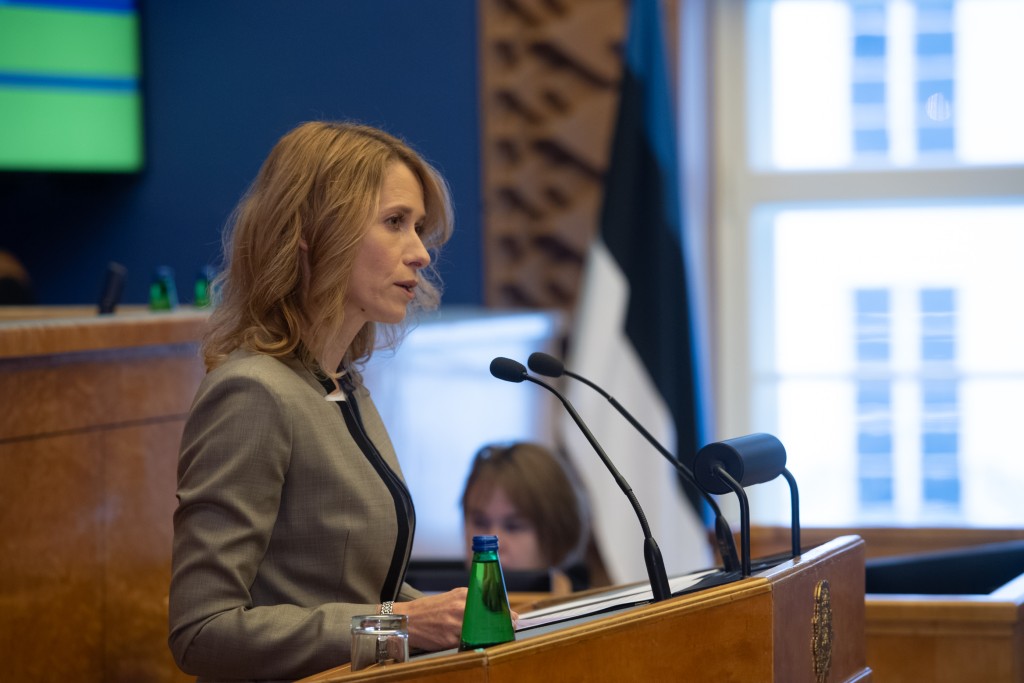
Stenbock House, 2 May 2022 – Prime Minister Kaja Kallas made a political statement in the Riigikogu today regarding the 802.9 million euro supplementary budget approved by the government before submitting it to the Riigikogu for debate. This budget covers the rapid reinforcement of national security and expenditure enabling Ukrainian refugees and Estonian people to cope in the ongoing crisis situations. A total of 247.6 million euros is to be allocated from the budget to strengthen broad-ranging security and resilience, 257.3 million euros to boost energy security and 242.7 million euros to cover primary costs associated with refugees from the war in Ukraine. For further details, see https://valitsus.ee/uudised/valitsus-kiitis-heaks-tanavuse-lisaeelarve.

