
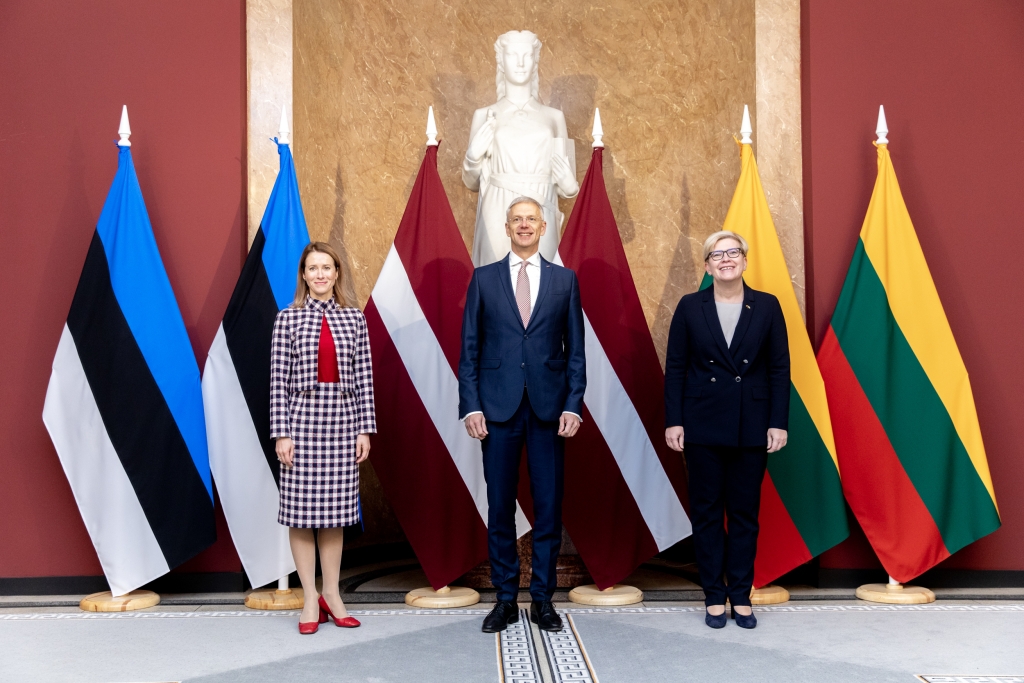
Dear Krišjanis, Ingrida, journalists,
First of all, I would like to thank Krišjanis for Latvia’s year of presidency of the Baltic Council of Ministers. 2022 has been extremely difficult and we have faced many challenges together. I am glad that our cooperation works well, that we have reached an agreement on all important matters and even more that we have jointly convinced our other allies in the EU and NATO.
I will begin with energy security. Together, we have made crucial decisions throughout the year to end dependency on Russian energy. We have managed to break free from Russian gas and at the same time ensure the security of gas supply in our region. Additionally, we have already ended electricity trade with Russia in spring.
The import of Russian crude oil to the European Union has been banned from 5 December and the oil price cap agreed by the G7 and the EU applies. In two months’ time, the ban on Russian oil product imports, already enforced in Estonia from 5 December, will enter into force in the EU. These are important steps to curb the revenues of the Russian war machine. Russia is planning on taking countermeasures to the price cap in the form of a price floor. This shows that the price cap is undoubtedly a hinderance to them. However, we need to do even more to reduce Russia’s energy income. We’ll return to discussions on the oil price cap in the EU in January.
We also discussed our readiness for different risk scenarios in the field of energy. In the event that a need emerged for the Baltic region to connect to the Central European electricity system, it would already be possible today.
Electricity and gas supply security is ensured if we coordinate our activities with our neighbours, both pre-emptively and even more so during a potential crisis. Therefore, Estonia wishes to enter into a regional agreement with Latvia and Lithuania to provide consumers with gas in the event of a disruption in the security of supply. I would also like to emphasise the importance of saving energy and electricity. We must all make a joint effort to reduce our consumption. We are all in the same energy region. If one of us makes an effort to save but others do not, the whole region will suffer. We are all clearly connected to one another. We must also have a solidarity agreement in place, so that if there is a need to restrict electricity supply, we could do it by following the same priorities across the board.
We also discussed the need to rapidly advance the construction of Rail Baltic in all of our countries – particularly in the changed security environment to ensure military mobility where necessary. An ever-increasing number of sites are being completed and the construction work of the main railway line will begin in Estonia next year.
Naturally, one shared interest that we discussed was supporting Ukraine. Our support to Ukraine will continue for as long as it takes for them to win the war. Talks of peace or a ceasefire today are premature and dangerous. This serves Russia’s military interests. A pause would give them the opportunity to prepare for a new offensive and also train mobilised troops.
Russian soldiers must leave the territory of Ukraine. This is the way to peace. I would like to reiterate that today this is not only a question of the security of Ukraine but the security of the whole of Europe. Territorial integrity, state sovereignty and prohibition of aggression are fundamental principles on which peace in Europe stands. The question is whether or not these principles apply. We cannot allow a situation where we let them be trampled on. For these principles to continue to apply, we need Ukraine to win and an unequivocal end to Russian aggression in Ukraine. Criminals must also face justice. A ceasefire established before these objectives are achieved does not ensure the security of anyone in Europe.
We must also look after our security ourselves. We have made several crucial decisions in Estonia, Latvia and Lithuania alike. In 2023, Estonia’s total defence expenditure will amount to over a billion euros. This forms 2.85% of the GDP. In 2024, the share of defence spending will exceed 3% of the GDP. This means that we will purchase more arms and equipment and build new infrastructure to host allied forces. These are very concrete and important steps to increase our defence. We hope that all of our allies will increase their defence expenditure as well.
Additionally, we discussed how to jointly proceed towards the NATO Summit in Vilnius next summer. Estonia’s wish is to ensure that the decisions made in Madrid, particularly those related to defence and deterrence, are followed up by the Vilnius Summit. We also wish to see progress in the strategic partnership of NATO and Ukraine and have Finland and Sweden behind the meeting table as full-fledged members.
Lastly, I would once again like to thank Latvia and you, Krišjanis, for your excellent work in chairing the Baltic Council of Ministers throughout this year. Next year, Estonia will take over this role. I am looking forward to hosting my Latvian and Lithuanian colleagues in Estonia in February.
Thank you.

