
Prime Minister Kristen Michal says the advancement of the defence industry is one of his government’s priorities, as it will bolster Estonia’s national defence and promote enterprise, boosting the economy. “The defence industry is an important part not only of national defence and security, but also of the economy,” he remarked. “In forming our government we agreed on specific amounts that would ensure that the industry brings as much benefit to our economy as it does to our defence capabilities.”
Prime Minister Michal added that the government had set itself the goal of creating better preconditions for growth in the turnover of the defence industry and for supporting cooperation between Estonian and Ukrainian companies, including in the rebuilding of Ukraine. “Our national plan is to accelerate the establishment of a defence industrial park so as to guarantee companies suitable conditions for product development,” he explained. “We are also planning to increase the volume of defence industry subsidies and to set up a special committee to deal with developments in the field.”
The next steps in advancing cooperation were agreed at the meeting, as were concrete tasks and formats going forward.
Taavi Veskimägi, the chairman of the supervisory board of the Estonian Defence and Aerospace Industry Association, says the new coalition agreement sends a long-awaited signal that there can be no talk of Estonia’s defence capabilities without there being a local defence industry. “This is a strong starting point, but if we are to promote Estonia’s defence industry, then it is also important to introduce that principle into national defence legislation, link local industry to the development of national defence capabilities and involve us in the planning process for defence capability needs,” he noted.
Veskimägi says that in the space of 15 years, Estonia’s defence industry has grown to a level where 10 local companies are producing different solutions that are helping Ukraine stand up to Russia’s aggression on a daily basis. “This shows that we are capable of developing world-class tools and technologies for our own country and defence forces too, as well as creating new jobs with high added value, significantly boosting export turnover and invigorating the economy as a whole,” he said, adding that defence industry companies require certainty and a long-term partnership with the state in order to promote all of this.
Under the aegis of the Ministry of Defence, Estonia’s defence industry policy is being overhauled in its entirety. This includes plans, supported by the state, to establish a defence industrial park in Ämari at which the production of ammunition could begin as early as next year. This spring, the government approved the creation of a defence industry fund worth 50 million euros. It will invest both directly and via private funds in defence industry companies and those developing dual-use technologies. With the support of the fund, Estonia’s defence industry companies will have the opportunity to develop and launch innovative products. The fund is open-ended, and recycled funds will be reinvested.
Founded in 2009, the Estonian Defence and Aerospace Industry Association represents the country’s leading companies in these sectors. It currently has 142 members.
Prime Minister meets with Defence Industry Association representatives
06.08.2024 | 00:00
Gallery
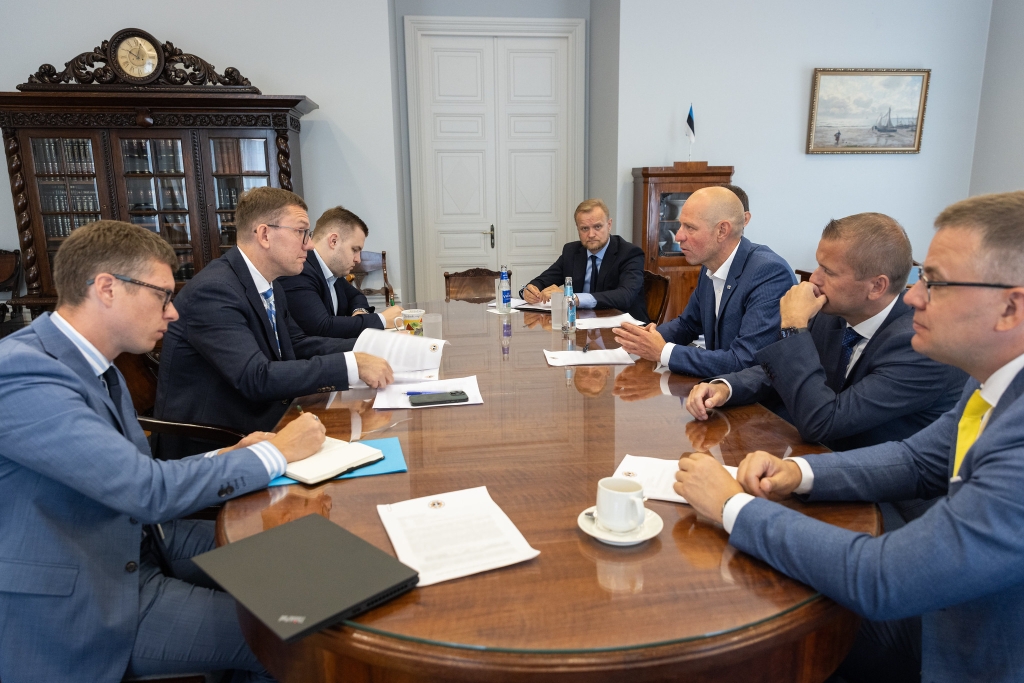
Stenbock House, 6 August 2024 – The head of government met today with representatives of the Estonian Defence and Aerospace Industry Association to discuss the sector and areas of state cooperation with the aim of making the field of defence more competitive and invigorating the economy.

