
Otto Strandman
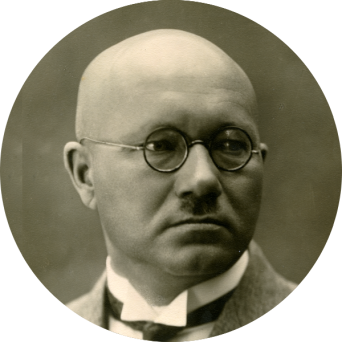
Otto Strandman led the forth composition of the Government of the Republic of Estonia as prime minister and the nineteenth composition as state elder (head of state). He was a layer, a politician, a pioneer of Estonian economy giving it a new and vigorous direction, a diplomat, and the head of his family.
Otto August Strandman was born in the new school building of the village of Vandu in Viru County on 30 November 1875. He married Lydia (née Hindrikson), with whom he had daughters Hella (1909) and Lydia (1914) and a son Hans (1910). Hella and Hans passed away only a few days apart in 1913.
Strandman was one of the founding members of the Estonian Radical Socialist Party with Jüri Vilms in the spring of 1917, and in the autumn of the same year, they changed the name of the party to Estonian Labour Party.
In 1939, Otto Strandman made the choice to withdraw from public life due his deteriorating health. He decided to spend his retirement years in Kadrina. After he received a formal notice to come to the headquarters of NKVD, Otto Strandman took his own life on 5 February 1941. He was buried in Siselinna Cemetery in Tallinn on 7 February.
Awards and acknowledgements
1920 – Cross of Liberty III/1
1921 – Order of the Estonian Red Cross
1928 – Order of the Estonian Red Cross II/II
1929 – Order of the Estonian Red Cross I/II
1930 – Order of the Cross of the Eagle I
Otto Strandman refused to accept any of the national honours.
Work and career
- 1940 – member of the management board of the company Põhja Paberi- ja Puupapivabrikud
- 1933–1939 – Estonian ambassador to France, Spain, Belgium, and Vatican
- 1931–1932 – member of the fourth and fifth composition of the Riigikogu
- 1929 – 1931 – state elder
- 1927–1929 – Estonian ambassador to Poland, Czechoslovakia, and Romania
- 1926 – member of the III composition of the Riigikogu
- 1924 – he served as the minister of foreign affairs and later as the minister of finance in the government led by F. Akel
- 1923–1924 and 1924–1926 – member of the second composition of the Riigikogu
- 1921–1923 – member of the first composition of the Riigikogu; in 1921, president of the Riigikogu
- 1920–1921 – minister of foreign affairs and minister of justice in the government led by A. Piip
- 1919 – 1920 – member of the Constituent Assembly
- 1919 – prime minister and minister of war
- 1918–1919 – minister of agriculture of the third provisional government led by K. Päts
- 1918 – minister of foreign affairs of the second provisional government led by K. Päts
- 1917–1918 – chairman of the Estonian Provincial Assembly; 1917–1919 – member of the Estonian Provincial Assembly
- 1917 – prosecutor of Tallinn District Court
- 1909–1933 – sworn advocate in Tallinn with intervals
- 1905–1909 and in 1917 – member of the Tallinn City Council
- 1903–1905 – a lawyer in Tallinn
Creator of the sense of justice
Otto Strandman had an important role in introducing the values of the rule of law and democracy to Estonians and helping them accept these values. To put it in general terms, he transformed an agrarian society into a modern one. The activities of Strandman in defending people who participated in the 1905 revolution were remarkable.
Architect of the New Economic Policy (NEP)
Although Strandman studied law, he was exceptionally well versed in economy and had a head for business. Initially, it became apparent when he chose the direction for the Estonian economy – where governments led by Päts focused on the Russian market and major industries, Strandman saw small land owners as the foundation of economic success.
In 1923, Strandman announced that the gold received with the Tartu Peace Treaty had run out and therefore, the Estonian economic policy of the time had failed. Strandman was tasked with finding a solution to bankruptcy that the Estonian economy was basically facing and avoiding hyperinflation as the minister of finance of the next government led by F. Akel. He switched to gold standard and managed to avoid the bankruptcy of the nation as well as establish a stable foundation for the economy to flourish. Estonian economy refocused on Western and Central European markets again.
Diplomat
Strandman served as the ambassador of Estonia to foreign countries several times: between 1927–1929 in Central Europe and between 1933–1939 in Western Europe. He was successful in his career as a diplomat because he was a skilled negotiator in political salons as well as had the manners of a gentleman. His persuasiveness also manifested in political processes in Estonia, starting from court litigations and all the way to the Riigikogu.
Ajavaod. Riigi mehed: Otto Strandman
Eesti Televisiooni portreesaated inimestest, kes on tegutsenud ja silma paistnud Eesti riigi loomise ja kujunemise aastatel. Loomulikult tuleb sarjas juttu ka sündmustest, milles loo kangelane on osalenud.
Vaata
Eesti lugu. EV 90: Otto Strandman
Vikerraadio "Eesti lugu" on rahvuse lugu ja kõikide Eestimaa rahvaste lugu. "Eesti lugu" jutustab sellest, kuidas me oleme eestlastena kõigi raskuste kiuste kolmeks tuhandeks aastaks püsima jäänud.
KuulaViited artiklitele ja uurimustele
Arvustus „Eesti mõtteloo“ sarja 136. raamatule "Otto Strandman „Raha rusikas“.
Eesti üleminek uuele majanduspoliitikale ja Otto Strandmani osa selles. Jaak Valge. Eesti Teaduste Akadeemia Toimetised 1991Teadusartikkel Eesti 1920-te majandusliku orientatsiooni muutumisest.
Mõjukad Eesti majandusmehed. Jaak Valge. Akadeemia 2006-8 (lk 1760-1777)Teadusartikkel J. Jaaksonist, O. Strandmanist ja J. Puhkist
The second government led by Otto Strandman (XIX composition of the Government of the Republic of Estonia)
9. VII 1929 - 12. II 1931
The second government led by Otto Strandman took office as a result of the elections of the fourth composition of the Riigikogu. Coalition was formed by the Estonian Labour Party (2), Farmers’ Assemblies (2), Settlers’ Party (2), Estonian People’s Party (1), and Christian People’s Party (1). Strandman led the government as the state elder and his cabinet had a total of eight ministers.
As a constitutional crisis was gathering momentum in Estonia, Strandman’s government had to tackle amendments to the constitution as an issue inherited from the previous government led by Jaan Teemant. At the end of 1929, the Farmers’ Assemblies submitted their second plan for constitutional amendments and at the beginning of the following year, the People’s Party followed suit. Both envisioned the creation of the institution of a president. The coalition parties agreed in preparing a joint plan for constitutional amendments but this composition of the government never managed to complete it.
During the time that Strandman’s government was in office, Estonia and Poland strengthened their relationship. In February 1930, Strandman went on an official visit to Poland. When returning, he stopped in Vilnius – a place of contention between Lithuania and Poland at the time – and this caused the relationship between Estonia and Lithuania to deteriorate. In August of the same year, Polish President Ignacy Mościcki visited Estonia in return.
Global economic crisis had a pronounced effect on the activities of the government. Tense relations between the agrarian parties culminated with the People’s Party leaving the coalition in January 1931. Strandman tried to find a new minister to replace Minister of Agriculture Kerem, but he failed to find a candidate that would have been acceptable to all coalition partners. Under these circumstances, Strandman announced the resignation of his government on 3 February 1931.
Cabinet ministers
- State Elder – Otto Strandman
- Minister of Agriculture, Deputy Elder of the State starting from 27 July 1929 – August Kerem (9 July 1929 – 23 January 1931)
- Minister of Roads – August Jürima (Jürman)
- Minister of Justice – Tõnis Kalbus (9 July 1929 – 12 April 1930)
- Minister of Justice – Ado Anderkopp (12 April 1930 – 12 February 1931)
- Minister of Education and Social Affairs – Jaan Hünerson (9 July 1929 – 12 September 1931)
- Minister of Defence – Oskar Köster
- Minister of Foreign Affairs, and starting from 26 January 1931, acting Minister of Agriculture – Jaan Lattik
- Minister of Economic Affairs – Johannes-Friedrich Zimmermann
The first government led by Otto Strandman (IV composition of the Government of the Republic of Estonia)
9. V 1919 - 18. XI 1919
This government led by Otto Strandman was the first government of Estonia which received its mandate from the Constituent Assembly elected by the people. The Estonian Labour Party, Estonian Social Democratic Workers Party, and Estonian People’s Party formed a coalition. The cabinet had a total of nine minister and Strandman served in the role of the minister of war in addition to being the prime minister. In September 1919, the Land Act passed by the Constituent Assembly led to a governmental crisis and the ministers of the Estonian People’s Party resigned from the cabinet.
'Understandably, the activities of the cabinet were mostly informed by the War of Independence, conducting the radical land reform along with the new economic policy focused on agriculture, and getting other countries to recognise Estonia. During the period that Strandman served as the prime minister, the most notable events of the War of Independence were Estonians fighting Landeswehr in North Latvia, and naturally, the Võnnu battle, where German troops suffered a defeat (19–23 June). Estonian troops reached Riga, where they assisted Latvians in their fight for their country. In October, Estonian army also supported Northwestern Army, which attempted to take over Petrograd. The government led by Strandman gave permission to start peace negotiations with Soviet Russia.
The land reform, planned and conducted under the leadership of Otto Strandman, was one of the most important socio-economic reforms in the history of Estonia. It changed the ownership structure of the land and farming significantly, providing plots to thousands of farmers who previously did not own any land, and improving their living conditions. The land reform helped modernise Estonian agriculture and increase its productivity. The diplomatic skills of Strandman and his international contacts helped ensure that other governments did not perceive the land reform as a threat, but a necessary measure for ensuring the economic and social stability of Estonia.
The foreign policy priorities of the government were focused on getting as much international recognition for the Republic of Estonia as possible. It was actively developing diplomatic relations with other countries and explaining the situation in Estonia as well as the ambitions and needs of the country at the Paris Peace Conference that took place during the same period. Its most significant achievement is the de facto recognition of the Republic of Estonia by Finland in August 1919.
The first government led by Otto Strandman had a remarkable role in guaranteeing and building the statehood of the Republic of Estonia. Strandman led the process of determining the basic principles for a democratic regime and he set the new country on a course to stabilise its economy.
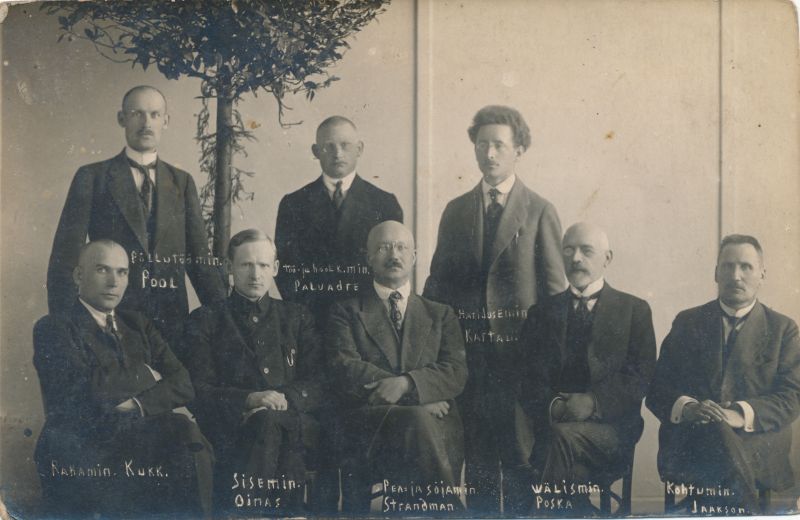
Cabinet ministers
- Prime Minister, Minister of War – Otto Strandman
- Minister of Justice – Jüri Jaakson (9 May 1919 – 23 September 1919)
- Minister of Justice – Lui Olesk (9 October 1919 – 18 November 1919)
- Minister of Education – Johannes Kartau
- Minister of Finance – Juhan Kukk
- Minister of Industry and Trade and Minister of Roads – Nikolai Köstner
- Acting Minister of Industry and Trade – August Janson
- Acting Minister of Industry and Trade – Märt Raud (9 June 1919 – 18 November 1919)
- Minister of the Interior – Aleksander Oinas (9 May 1919 – 18 July 1919)
- Minister of the Interior – Aleksander Hellat (29 July 1919 – 18 November 1919)
- Minister of Labour and Welfare – Anton Palvadre
- Minister of Agriculture and Food – Theodor Pool
- Minister of Foreign Affairs – Jaan Poska (9 May 1919 – 23 September 1919)
- Acting Minister of Foreign Affairs – Jaan Tõnisson (6 June 1919 – 29 July 1919)
- Acting Minister of Foreign Affairs – Ants Piip (9 October 1919 – 18 November 1919)
„Otto Strandman“, autor Tiit Pääsuke
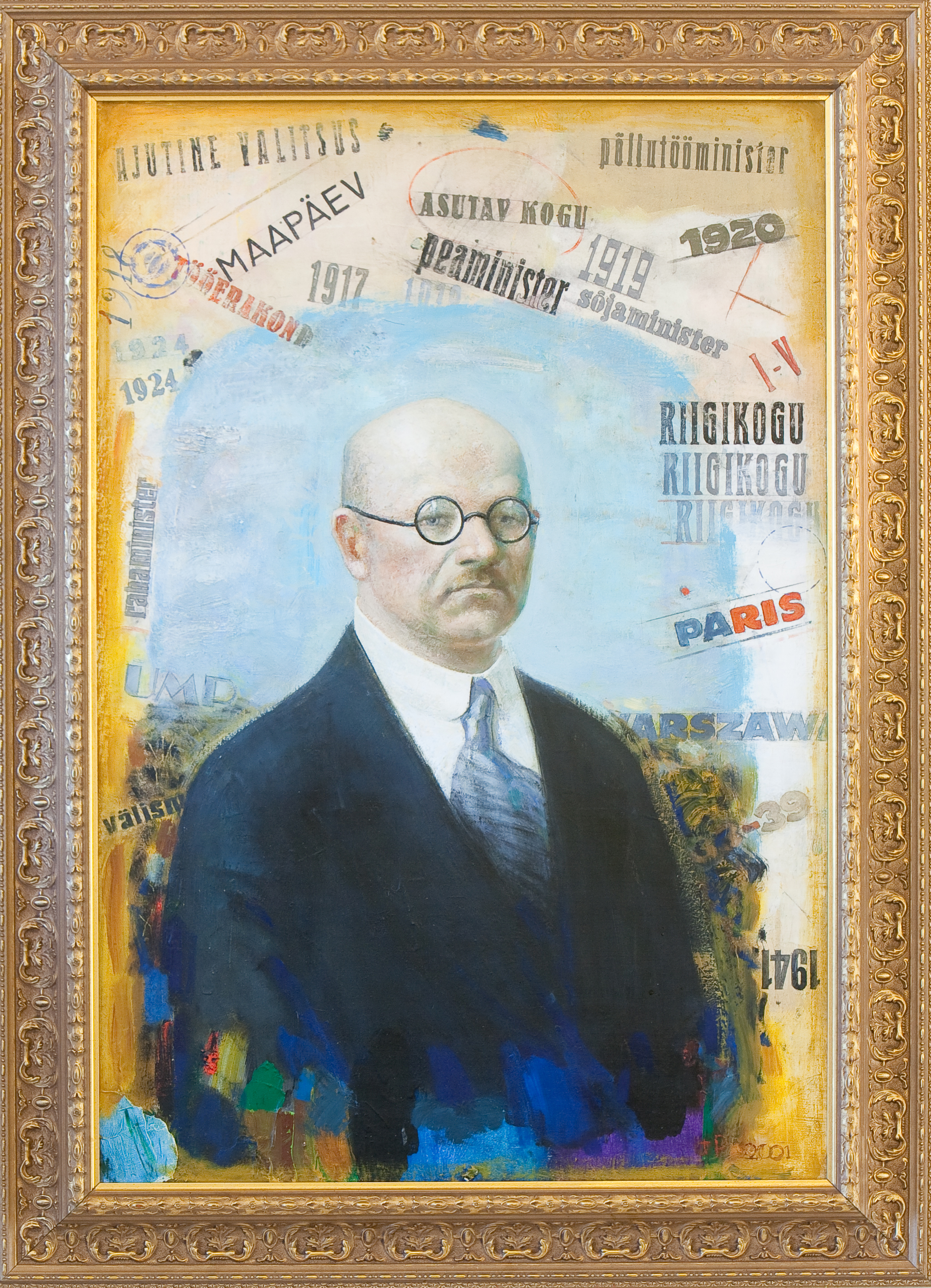
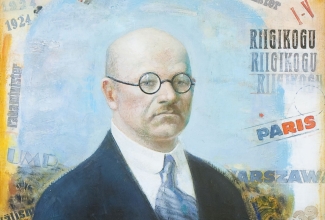
Maalikunstnik Tiit Pääsukese portreemaal Otto Strandmanist võtab kaasaegselt ja tabavalt kokku suurmehe isiksuse, ametitegevuse ning pärandi. Teos on sümbioos Strandmani elukaare sündmustest, fotode põhjal loodud tõetruust kujutisest ning idealiseeritud Eestimaast. Portreemaali kihilisus haarab kaasa ning pakub sõnumirohkust ja nauditavat elamust igale vaatajale.
Portreemaal asub Stenbocki maja riigivanemate saalis, see valmis 2001. aastal.