
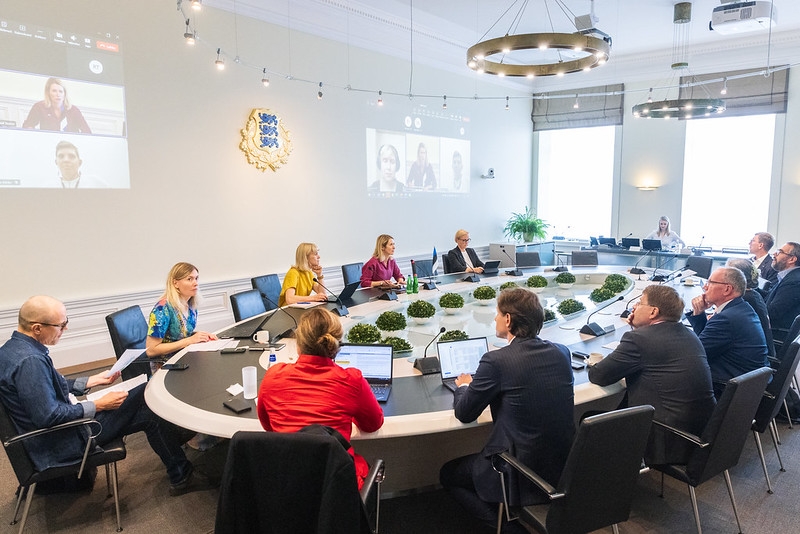
According to Prime Minister Kaja Kallas, the projects that received support from the Research and Development Council today will help to overcome challenges important for Estonia, which will lead us towards an even more sustainable and secure country. “We need to channel the funding for research projects in a way that society can benefit from them as much as possible,” the prime minister stressed. “For example, we need to work with researchers to find solutions to the energy challenges of the future, such as the wider deployment of hydrogen or the exploration of rare-earth elements. At the next meeting of the Research and Development Council, we want to formulate the principles for the R&D funding of ministries so that they are based on the actual needs of the country.”
The first project to receive support from the Research and Development Council aims to clarify the CO2 sequestration capacity of Estonian land and soil use. Upon the implementation the project, collaboration with researchers will lead to a holistic solution based on innovative approaches. The solution is essential for shaping policies related to the climate, biodiversity, and land use, for addressing the environmental challenges that the country is facing (restoration of ecosystems, increasing biodiversity, transposing the Soil Directive, spatial planning of land take land use, etc.) and for meeting its obligations (LULUCF requirements, climate targets).
The second supported project aims to create a model of a future-proof data economy ecosystem and infrastructure solutions for secure data processing. The main objective of the project is to develop a much broader approach than the current X-tee to ensure that the data ecosystem in Estonian society is sustainable and secure.
Third, the Research and Development Council will propose to the government to support the establishment of a cancer research and treatment centre, which would be dedicated to diagnostics, treatment, and prevention as well as cancer research. The establishment of the centre would be linked to one of the five missions highlighted under Horizon Europe and would be eligible for future EU funding.
Fourth, the Research and Development Council supported the evaluation capability of cryptographic security solutions that would provide science-based input to ensure the cybersecurity of the country.
Fifth, the Research and Development Council approved a plant breeding project to develop new breeding techniques. The implementation of the project would allow Estonian researchers and plant breeders to advance in new breeding techniques to provide farmers with varieties suited to Estonian conditions quickly enough to help ensure food security and maintain the competitiveness of agricultural production.
The sixth supported project explores the evolution of society’s vulnerability to crises.
Seventh, the Research and Development Council supported a project on collective memory, focusing on the history of Estonian foreign and security policy and diplomacy.
In the coalition agreement, the government has committed to allocate at least one per cent of the GDP to research and development. It has been agreed that 40 per cent of this will be channelled to support the research system, 40 per cent to help businesses grow R&D and innovation, and 20 per cent to research-based policy-making.
According to the 2021 proposal of the Research and Development Council, the additional funds for ministries will be distributed in two parts – a basic part, which all ministries will receive on the basis of a formula, and a competitive part, which will be allocated by a decision of the government on the basis of applications.
The Research and Development Council decisions made today concerned precisely these measures.
The government will decide on the funding of these measures after hearing the proposals of the Research and Development Council.
In addition, the Research and Development Council discussed a study commissioned by the Ministry of Economic Affairs and Communications on the impact of the new centre for applied research on the Estonian research system. The discussion will continue at the next meeting.
The Research and Development Council has 15 members and its composition is approved by the Government of the Republic for a maximum of three years. The Council is composed of the prime minister, the ministers responsible for the sectors, the members of the Government of the Republic appointed by the prime minister, and 10 members appointed by the Government of the Republic.
Read more about the Research and Development Council: https://valitsus.ee/valitsuse-eesmargid-ja-tegevused/teadus-ja-arendusnoukogu-tan

