
Siim Kallas served as Prime Minister, Minister of Foreign Affairs, and MInister of Finance of Estonia; Vice-President of the European Commission; and was a long-serving member of Riigikogu. He was one of the authors of the proposal for a self-managing Estonia, a leader of the 1992 monetary reform, and a founder of the Estonian Reform Party. His work directly influenced the shaping of Estonia's restored economic system and the country's accession to the European Union and NATO.
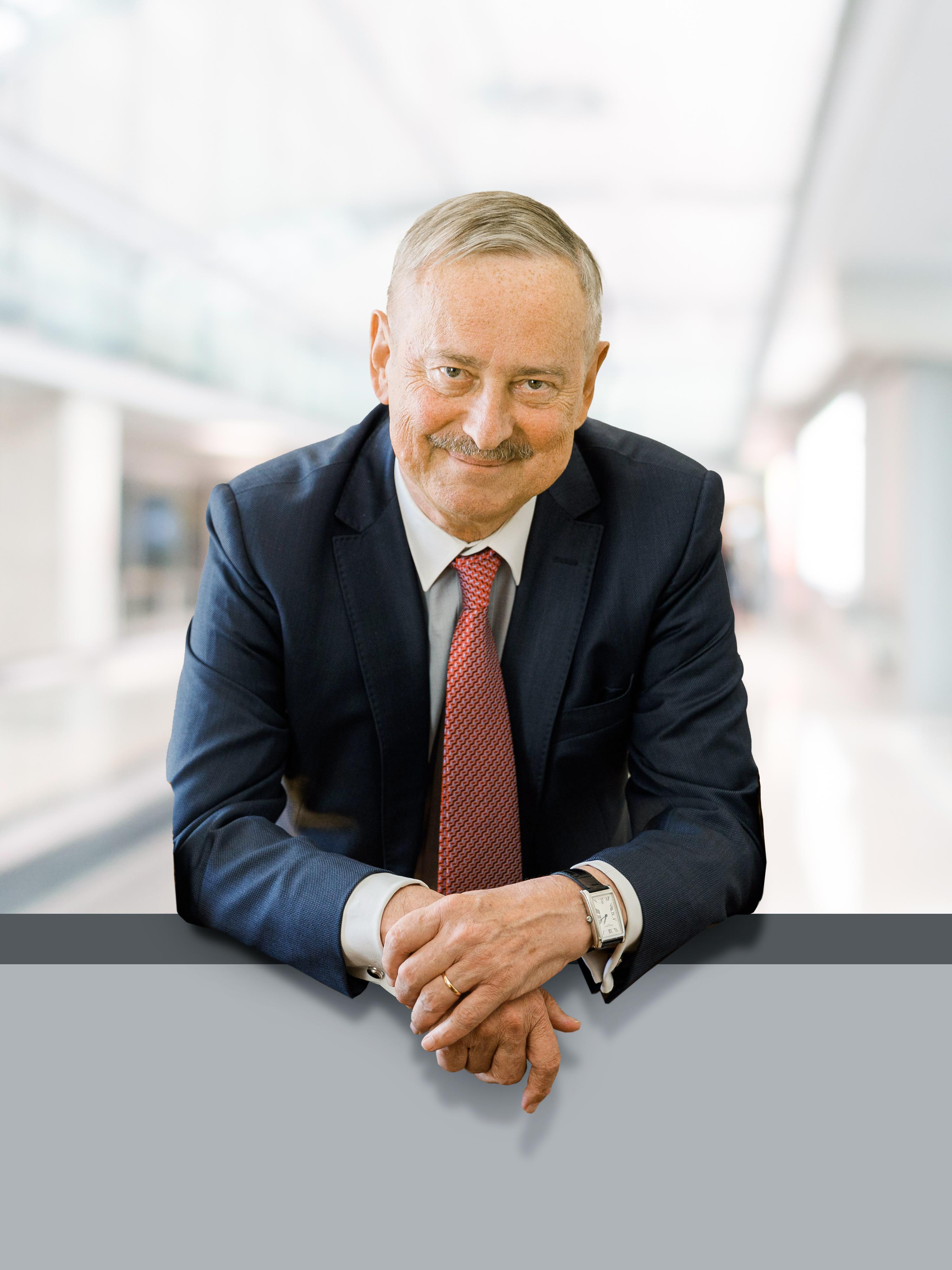
Biography, Orders of Merit
- 2023–2024 Member of XV Riigikogu.
- 2019–2023 Member of XIV Riigikogu, 2021–2022 Chairman of European Union Affairs Committee.
- 2017–2019 Viimsi Municipal Mayor.
- 2010–2014 European Commissioner for Transport.
- 2004–2014 Vice-President of the European Commission.
- 2002–2003 Prime Minister.
- 1999–2002 Minister of Finance.
- 1995–1996 Minister of Foreign Affairs.
- 1994 Founding member and chairman of the Reform Party
- 1991–1995 President of Eesti Pank.
In 2003 Siim Kallas was awarded the Order of the National Coat of Arms, 2nd Class, for services rendered to Estonia, and in 2015, the Order of the National Coat of Arms, 1st Class.
In 2001, Siim Kallas received France's highest honour, the Order of the Legion of Honour (4th Class, or Grand Officer).
In 2000, Kallas was awarded the Order of Merit of the Federal Republic of Germany, and in 2019, the Order of Merit of the Republic of Poland, 3rd Class (Commander's Cross).
Movement of the hearse from the home to the Estonia concert hall
The hearse travels from Viimsi, through the city and Toompea, to the front of the Estonia Concert Hall.
The first commemorative pause takes place at the Viimsi municipal building at 9:40 a.m. Representatives of the Viimsi municipal government and council have gathered in front of the building. The hearse is sent on its way to the sound of the trombone (soloist Ruslan Trochynskyi).
At 10:40 a.m., the hearse arrives in front of the Estonia Concert Hall. The coffin is received with military honors by the Guard Battalion’s honor company and the military orchestra.
From 10:57, representatives of Viimsi Municipality, the Reform Party, the Ministry of Foreign Affairs, the Ministry of Finance, the Bank of Estonia, and the Riigikogu will stand guard of honor by the coffin.
A pause is observed for a minute of mourning at
- 9:40 Viimsi Municipal Building
- 10.10 Ministry of Foreign Affairs
- 10.15 Eesti Pank
- 10.20 Ministry of Finance
- 10.26 Riigikogu
- 10.30 Stenbock House
11:00 Public farewell in the concert hall
The doors of the Estonia Concert Hall will open to the public at 11:00 a.m.; please leave outerwear and large bags in the cloakroom. There is also an opportunity to sign a book of condolences. Flowers should be placed on the catafalque and podiums located in the cloakroom area. Guests will then proceed up the stairs to the main hall. After paying their respects, guests may take their seats in the rear of the hall or in the balcony.
13:00 National memorial ceremony at the concert hall
Performed by Estonian National Symphony Orchestra (ERSO), conductor Olari Elts
Opening remarks by announcer Kristjan Üksküla
National Anthem of Estonia
President of the Republic Alar Karis
The current and former prime ministers place a gavel on the coffin
Prime Minister Kristen Michal
Edvard Grieg's "Solveig's Song" from the "Peer Gynt" No. 2
Former European Commissioner Olli Rehn
Gennadi Podelski, „Reflection“ (Mõtisklus), lyrics by Heldur Karmo, arrangement by Rasmus Puur. Tamar Nugis, baritone
President of Eesti Pank Ülo Kaasik
Honorary Member of the Estonia Society Arne Mikk
Helena Lotman will read the tribute from the Kallas family
Robert Schumann's „Evening Song“ (Abendlied)
Movement No. 5, "Homeland Melody," from Heino Eller's "Five Pieces for String Orchestra".
Honours rendered by the Defence Forces Honour Guard, Military Orchestra, and salute volleys in front of the concert hall.
Even the strongest eventually run out of strength, and their steps come to a halt.
In The Bagpipe and the Knife, the last book Siim Kallas wrote and one that meant so much to him, he observed: “A good idea, good execution, public support and – the right timing. If you are too late, the idea will drown in pointless debate; if you move too quickly, the time will not yet be ripe.”
Although this reflection concerned monetary reform, it also captures how, in even the most varied circumstances, he knew how to guide Estonia’s course in a way that has helped us endure and, most importantly, move forward with confidence and momentum.
Siim Kallas’s stature in the life of our nation and state cannot be measured by the offices he held alone. His role and influence extended far beyond them.
Siim Kallas never shied away from bold ideas for advancing life in Estonia, and he knew that ideas had to be put into practice; otherwise, we risked remaining invisible in our small and remote corner of the world.
This was how he helped Estonia grow into a modern country that values freedom and did everything in his power to bring us back into Europe. This was, and remains, a matter of vital importance to our security – but it was about far more than security alone.
Siim Kallas understood that the survival of the Estonian language, culture and statehood was possible only through openness, free and courageous debate and dialogue, and active participation in shaping Europe’s future. He did not stand aside or wait for more favourable circumstances; he did everything in his power to help bring them about.
With energy and passion.
This comes as no surprise, for everything he did was guided by an open outlook and a broad perspective, by respect for Estonia and a sense of responsibility towards it, and by his love for his family and the story of his people.
One of the finest expressions of all this is the work of the Kristi and Siim Kallas Fund in supporting Estonian theatre and its interpretations of our history.
Estonia has lost a statesman who knew how to turn a good idea into a mature achievement.
My deepest condolences to Kristi, Kaja and Ülo and their families, and to all those closest to him.
Thank you, Siim Kallas. Rest in peace.
Dear members of Siim Kallas's family, dear friends,
President of the Republic, President of the Riigikogu, Chief Justice of the Supreme Court, representatives of foreign countries.
Dear compatriots who have gathered to pay their respects to Siim Kallas.
Siim Kallas was a great statesman and a great politician. He was one of the people whose decisions helped Estonia become what it is today – democratic, European, respectful of individual freedoms and self-reliance.
I knew Siim for over 30 years and we went through thick and thin together. And that is why, here today at his memorial ceremony, I refer to him as Siim.
Siim shaped Estonia's development to a large extent over the past half-century. He lived for Estonia - with great passion, great dedication and great ideas.
He was also a great democrat, helping to instil self-confidence in Estonia at a revolutionary time when we had to simultaneously rethink our institutions, economy and place in the world. First came the laying of solid foundation for finance; then, in politics, paving Estonia's way towards membership of the European Union and NATO and, of course, his work for a united, stronger and safer Europe.
It was also about outlook. The conviction that Estonia could shape its own future by making clear and lasting choices. He was committed to freedom, Estonia's independence and our place in democratic Europe and the wider world. That was always his cause - inspiring, persuading, and taking action.
For many of us, Siim is undoubtedly synonymous with monetary reform. The introduction of the Estonian kroon was a bright moment, but the true significance of the monetary reform becomes even clearer with the passage of time.
The Estonian kroon was not only beautiful but also became the economic mainstay of a country that had only just regained its independence. It gave the people of Estonia confidence in their country and safeguarded the value of their work and incomes.
A stable currency helped lay the foundations for an economy that has developed at an extraordinary pace over the past three and a half decades. Estonia did not become prosperous because of any single decision. Yet without the decisions that created a reliable and trusted currency, our success story would have rested on far more fragile foundations.
"Pegging the kroon to the German mark created trust, everyone understood that the kroon was as good as the German mark," Siim Kallas later recalled the key decisions of the reform.
In this way, the Estonian economy was linked to Europe´s financial future from an early stage. We were part of the evolution towards a single European currency from the very beginning. It can even be said that the monetary reform predetermined the introduction of the euro in Estonia; the only question was when it would happen.
Siim's decisions were shaped by his understanding of Estonia's place in the world. Estonia had to anchor itself in the democratic world — economically, politically and in terms of security. We had to return to the community of shared values to which we belonged by virtue of our history, our culture and our own choices.
Siim understood very well that for a small country, the grey zone is not a safe transit option. Estonia's freedom and success require friends and allies – those with whom we can share our successes and to stand shoulder to shoulder in difficult times.
“For me, the guiding principle behind all our international engagement has been ‘Never again alone’,” as he once succinctly put it.
After entering Estonian politics, Siim Kallas, as Minister of Foreign Affairs, formally submitted Estonia’s application for membership of the European Union.
During his term as Prime Minister, Estonia completed its negotiations on accession to the European Union.
At the same time, we crossed the threshold of NATO membership.
These were decisive moments for Estonia.
Yet he did not see accession to the European Union or NATO as the ultimate goal. It was a new beginning.
The beginning of the greater responsibility we bear towards ourselves, our country and our allies. The beginning of a journey on which we are no longer just recipients of security and assurance, but increasingly help to create and provide both.
Siim Kallas has described it as follows:
“Virtually every decision made in the European Union has some kind of global impact. It is quite difficult for a representative of a small and distant nation to adjust to this. But we've adapted. Never before have representatives of the Estonian people had such an opportunity to participate in world affairs.”
“This participation also means sharing responsibility. Representatives of small Estonia are expected to take responsibility and contribute to global climate policy, security and migration policy, to shaping the global economy, and to solving other problems. If we lack a sense of responsibility and the will to accept it, then this unprecedented opportunity to have a say in shaping the affairs of Europe and the world is meaningless. It will just be squandered.”
He applied this principle at the European Commission — as Estonia's first European Commissioner, as a Vice-President of the Commission, as European Commissioner for Transport.
Siim Kallas went to Brussels with a clear purpose. He went to build Europe.
He came from a country that had been forcibly cut off from Europe for five decades. Perhaps that was why he felt particularly strongly that Europe must be truly united. For people and businesses, in a tangible way and adding value.
He understood that Europe's freedom and strength depended on how well interconnected it was - through roads and railways, electricity and gas interconnections, and communications networks. These connections foster economic growth and make solidarity and security possible. Siim transformed the idea of connecting Estonia and other Eastern European countries with the rest of Europe into a reality, backed by the political support and budget of the European Union.
We need look no further than Estonia to appreciate the foresight of his initiatives: the gas and electricity interconnections with Finland, and Rail Baltica. In essence, all of them embody a great deal of Siim Kallas’s vision and determined efforts. All of them were, or are being implemented with the vision of a united Europe and with support from the EU budget.
The greatness of a statesman is not just about making the right decisions at the right time. It also means that these decisions will prove their worth decades later. Siim Kallas had that rare gift, coupled with a sharp mind, courage and perseverance!
He made no secret of the fact that being at the highest levels of Estonian and European politics also appealed to him personally. “You can be anything, but it is politicians who make decisions. Inevitably, half the people will dislike the decisions you make. The sweet agony of decision making. That's what fascinates me about politics.”
Siim was one of those politicians – and one of those people – who was always warm-hearted and radiant. He was a leader in every sense – a driving force behind ideas and the life and soul of every gathering.
What mattered to him was people’s ability and willingness to act, not necessarily their place in the hierarchy. I experienced this myself as a young person interested in politics: Siim welcomed me and other young people to the table as equals. He dispelled the awe we felt on first meeting someone who was already a towering figure. He gave us the opportunity to act and take responsibility.
Ever since, I have been guided by one of his maxims: never favour the advice of friends and acquaintances over that of those who bear responsibility for their work. That's the principle I've been following. It has always proved to be sound advice.
Estonia and Europe are not finished projects. They are shared endeavours that must be preserved, strengthened and built upon.
Siim showed us how: with clarity of vision and firm resolve, trusting our allies and believing in Estonia’s own capabilities.
Our task now is to carry that vision forward – neither to forget or neglect it. Our task is to strengthen what remains fragile. To look beyond today’s difficulties and to make decisions whose wisdom will be borne out by time.
Siim’s many talents extended far beyond politics, economics and statecraft. He was cultured to his very core – a true connoisseur of the arts in the finest sense of the word. He read widely, loved poetry and literature, opera and theatre. For him, culture was not merely a ceremonial activity, but a natural part of life.
I will now read a stanza from the poem by one of Siim's favourite poets – Paul-Eerik Rummo:
Then love my eyes
when they hold the heavens of the world,
and sing only that verse of mine
that is woven from my heartache,
that is woven from my heartache
when I sense dangers yet unknown.
This verse is born of my heartache:
will we know how to hold together,
will we know how to hold together
like a frightened swarm of bees,
will we know how to hold together
and thus make our way through the sea?
Dear Kristi, Kaja and Ülo, dear family. Dear friends and acquaintances of Siim,
Estonia is freer, more prosperous, more influential and more secure today because Siim tirelessly believed that it was possible. Siim believed that we could hold together and make our way through the sea!
The whole of Estonia bows its head in gratitude.
Thank you, Siim Kallas!
Dear Kristi, Kaja, Ülo and the entire family,
Dear friends of Siim, Ladies and Gentlemen,
We have come together today to remember a remarkable Estonian, a great European — and, for many of us, a dear friend.
I had the privilege of sitting beside Siim around the same Commission table in Brussels for ten years. Today I am representing the Barroso Commission, where Siim served as Vice-President – but I am here, above all, as someone who has lost a great friend and trusted colleague.
More importantly, Estonia has lost one of the founding fathers of its restored independence. Europe has lost a statesman who helped change the course of his country and contributed to shaping the EU as a whole.
Siim was both a visionary and a doer.
Siim belonged to the generation of Estonians who dared to imagine independence long before the world believed it possible.
The IME programme for Estonian economic self-governance, in 1987, was a milestone on that road. We often recalled his visit to Turku in 1988, presenting that bold initiative to a Finnish audience that listened politely — but did not quite believe him.
Today we know where that road led. But in 1988, nothing was certain.
That tells us something essential about Siim: he could see the destination before the road was visible — and then he started building the road.
The great destination was Europe.
For Siim, Estonia’s membership in the European Union and NATO was never simply about security or the economy. It was about Estonia’s historical place: returning to Europe — to the community of free and democratic nations to which it belonged.
He knew that the country’s restored independence had to be made permanent. A small nation needed strong institutions, a sound economy and reliable allies. It could never again be left in a grey zone between East and West.
Siim helped build the new Estonia and lead his country towards Europe. As Prime Minister, he saw Estonia complete its EU membership negotiations in 2002. Two years later, Estonia joined both the European Union and NATO.
Estonia was home in Europe again.
But for Siim, that was not the end of the journey. When Estonia joined the European Union in 2004, Siim became its first European Commissioner and soon Vice-President — and he belonged there naturally.
Siim’s Europeanism grew from Estonia’s history. He knew what it meant to lose freedom, and so he understood the value of European unity. He knew what it meant for a small country to be left all alone, so he recognised the value of solidarity.
Siim proved that a country’s voice in Europe depends not on its size, but on the calibre and persistence of those who represent it.
I came to appreciate these qualities very much over our ten years together — not least when Europe was tested during the euro crisis, when his support meant a great deal to me. In difficult moments, Siim’s judgement was something I sought, and I could always trust his word.
We had one small advantage over our colleagues around the table. When tough issues needed to be briskly moved along towards the goal, we could resort to our own encrypted code: Finnish. It was no conspiracy, but most effective many a time – and always quite secure indeed.
For Siim, Finland was never just a neighbour. He spoke our language beautifully, followed our news, told our jokes — and had probably more Finnish friends than most Finns do!
As Governor of Eesti Pank, he was at the heart of rebuilding Estonia’'s central bank, working closely with Suomen Pankki.
Years later, as New Year’s Day 2011 began, I stood with Siim in Tallinn by an ATM at midnight to witness Estonia joining the euro. It was twenty degrees below zero. Siim was holding freshly printed Estonian euro banknotes in his hand.
I have always liked that image: the young economist pursuing a bold idea of Estonian economic self-governance now standing in a firmly independent Estonia and holding the common currency of Europe.
That was quite a journey.
Ladies and Gentlemen,
Today, when Europe is again confronted with war, uncertainty and polarisation, the life’s work of Siim Kallas speaks to us with particular force.
Europe is never finished. It is always work in progress.
Every generation must continue building it — defending freedom, strengthening democracy and making sure that no European nation is ever left alone.
Dear Siim,
Thank you for your friendship, and for the years we worked together. Thank you for your tireless efforts for the success of Estonia and Europe — and for the bridges you helped build between Estonia and Finland.
Dear Kristi, dear Kaja, Ülo and the entire Kallas family, please accept my deepest condolences.
Puhka rahus, kallis Siim. – Rest in peace, dear Siim.
Dear friends,
Today we bid farewell to a leader and visionary whose life’s work has left a profound mark on the history of the Estonian state and the Estonian economy.
From a central banker’s perspective, one period stands out particularly clearly in Siim Kallas’s legacy – the monetary reform of 20 June 1992.
It gave Estonia its own currency. In hindsight, this step may seem natural and straightforward, but for a newly re-independent country and its leaders it required a vast number of extremely complex and consequential decisions. We had no readily available examples to follow, and international advisers were more inclined to say “don’t do it”, because the risks were so great. No one knew what would happen. Yet in Estonia there was a clear understanding and sense that “the Estonian people wanted to have their own currency, that currency had to be ‘hard money’, and it was needed as quickly as possible”, to quote Siim Kallas.
As Governor of Eesti Pank, Kallas took decisive leadership of this process, inspiring colleagues and those around him with his passion, courage and determination to accomplish great things: to secure Estonia’s freedom and independence.
And Estonia did get hard money. This was ensured by the kroon’s fixed peg to the German mark and by a monetary system based on the currency board principle. Amid economic chaos, this gave the young state something immensely valuable – predictability. People and businesses could be confident that there were clear rules for preserving the value of money and that those rules would be observed. Stability began to emerge, along with the confidence to invest and build for the future.
“A strong national currency was like a pole in a blizzard – it stood firm and gave you something to hold on to,” Siim Kallas recalled when, a few years ago at Eesti Pank, we marked the thirtieth anniversary of the monetary reform.
The choices made at the time also established the principles on which Estonia’s subsequent economic policy would come to rest. Because the kroon’s exchange rate could not be changed and the central bank could not support the economy or the government by creating money, the economy itself had to adjust. Companies had to become more productive, prices and wages had to develop in line with market conditions, and the state had to align its spending with the resources available to it. A balanced budget was therefore treated as an inviolable principle. This helped foster a cautious attitude towards debt, fiscal discipline, and an understanding that, over the longer term, we can primarily spend what we ourselves are capable of earning.
Sound money and sound public finances were two sides of the same coin.
The monetary reform also shaped Estonia’s credibility beyond our borders. Once it became clear that the kroon was stable and that Estonia was abiding by the rules it had set for itself, attitudes towards Estonia changed as well. That credibility became a cornerstone of the foundation on which Estonia’s further integration into the European Union and NATO was built. The constraints and sense of responsibility learned during the currency board years also prepared the Estonian economy for joining the euro area. The currency changed, but not the principle that credible money requires credible economic policy.
Siim Kallas continued to stand by these principles decades later and warned against living carelessly on borrowed money. “Borrowed bread and a fire of wood shavings – neither lasts long,” he would say, quoting an Estonian proverb. Every loan must eventually be repaid. What concerned him most, however, was a change in mindset – whether we still believe that we must create our own prosperity and opportunities first and foremost, or whether we expect someone else to solve our problems for us.
The Estonian kroon has now been replaced by the euro, and Eesti Pank is part of the Eurosystem. But the questions that had to be answered in the early years of restoring the Estonian state have not disappeared: how to create confidence and trust in uncertain times, how to preserve the value of money, how to make decisions with a long-term perspective, and how to take responsibility for those decisions. Siim Kallas’s legacy is therefore not merely a chapter in Estonia’s economic history. It lives on in the understanding that credibility must be earned and that rules must be upheld – even when doing so is difficult.
Rest in peace, Siim Kallas. My deepest condolences to his family and loved ones.
My heartfelt condolences, dear Kristi, and to all Siim Kallas’s loved ones and those who shared his journey.
Five years ago, Siim wrote a book titled Eduard Alver: His Time and His Contemporaries. It begins with the dedication:
“To my mother, Rita Kallas, who kept alive the memory of her father, Eduard Alver, who died at a young age, and preserved faith in the Republic of Estonia.”
The central figure of the book is Siim Kallas’s maternal grandfather, whom Siim never knew, but whose family’s dedication to an independent Estonia helped shape some of his fundamental convictions.
Siim’s sudden passing and the many tributes paid to him seem to call for a new book entitled Siim Kallas: His Time and His Contemporaries.
While bringing our political culture to an international level, Siim remained deeply devoted to Estonian culture – a culture whose earliest professional achievements are closely associated with the Estonia Theatre and Concert Hall. This building opened in 1913, before Estonia gained its independence. That same year, Siim’s father, Udo Kallas, was born.
He played the clarinet and saxophone in well-known Tallinn ensembles and ended his career with the Estonian Radio Variety Orchestra. That orchestra performed countless times in this very hall, and during the pauses in today’s performance by the Estonian National Symphony Orchestra, we may imagine hearing the notes of Udo Kallas’s clarinet still echoing within these walls.
Few people probably know that Siim Kallas himself once played the clarinet in the Tallinn Fire Brigade brass band and that, while serving as Estonia’s Minister of Finance, he received a valuable saxophone from his colleagues as a birthday present. It seems that only members of his family ever heard him play it.
Kristi and Siim Kallas were members of the re-established Estonia Society for 19 years. In 2009, they established a fund bearing their names within the Cultural Endowment of Estonia, with the aim of supporting theatrical interpretations of Estonian history.
They joined the friends’ associations of both the Estonian National Symphony Orchestra and the Pärnu Music Festival, and attended performances at the Estonian National Opera as Gold Card holders. Their cheerful faces always reflected a spirit of faith, hope and love.
In a fairly recent interview, Siim said: “You know, I would really like to talk about culture, but no one is interested.”
As a member of the Riigikogu, he was one of the most active supporters of the proposed extension to the Estonia Theatre, hoping one day to see productions staged there on the scale originally intended.
Kalju Lepik wrote a short poem:
When the heart stops,
time stands still.
Space becomes boundless.
All speech recedes into the distance.
A single tear,
a solitary star.
Still it shines.
Thank you, dear Siim. Your star will continue to shine in the firmament of Estonian history for all time.
Dear Dad,
For the past twenty-five years, whenever you celebrated a milestone birthday, you had one request: that I should give the speech. That way, you could turn down everyone else who wanted to speak, because in your view, speeches at birthday celebrations were rarely about the person whose birthday it was. They usually began with how the speaker knew the guest of honour, then moved on to the speaker themselves – and all of that took far too long. You wanted to get on with the dancing, eating, drinking and celebrating. And so you established a rule for your birthdays: only you and I were allowed to give speeches. Today, however, is not a day for celebration, and I am certain that you would have enjoyed hearing people say so many kind things about you. But in keeping with our agreement, I shall try to do my part as well.
When the news of your passing became public, my brother and I received many messages saying that our father had been a great man. An important man. And you were. You did so much for Estonia, and we are so proud of you. You were behind many important decisions and events that shaped life in Estonia: the proposal for an economically Self-Managing Estonia, the Estonian kroon, the abolition of corporate income tax, and so much more. But to my brother and me, you were first and foremost our father. A wonderful father. A thoroughly good person. We cannot choose our parents, but my brother and I were incredibly lucky.
You always had a deeply positive view of people. As a rule, you trusted them unless they gave you reason not to. Because of this, you had many friends and good acquaintances. From time to time, you were hurt when someone betrayed your trust, but you remained convinced that there was far more to be gained from trusting people than from treating everyone with suspicion. That is why your friends and acquaintances were of all ages, from all walks of life and of many different nationalities. From an early age, you taught my brother and me that everyone should be treated with respect. Titles, jobs and positions come and go, but the person you are remains. And in this, you set us a wonderful example.
As well as forming new friendships, you taught us to cherish the friends who had stood by you throughout your life. You and Mum had a close-knit circle of friends from your university days who continued to meet regularly. They were intellectually curious and always ready to debate and discuss the major issues facing society – but parties were no less important.
You always loved a good party. Whenever there was something to celebrate, it had to be celebrated properly. Your zest for life was infectious. In our family, every birthday, wedding anniversary and other special occasion was marked with a large gathering and a party.
You were always ready to join in with all sorts of adventures, and you loved organising them yourself as well – whether it was a cycle ride from Viljandi to Tartu for a wedding anniversary, an orienteering competition in torrential rain for my birthday, or even my brother’s UFO-themed milestone birthday just two years ago, to which you and Mum happily turned up dressed as aliens.
Not taking yourself too seriously, together with your sense of humour, was something that carried you through life. There was always plenty of laughter in our family – and not only at parties. You could play a prank at any moment.
Once, for example, you signed an email “Siim E. Kallas”. When we asked what the “E” stood for, you announced that it was your stage name.
On another occasion, our neighbours in Püünsi held a gathering to which they had also invited some distant relatives. The relatives were apparently very nervous when they heard that Siim Kallas would be there. Our neighbours reassured them: “Oh no, don’t worry – Siim is very down-to-earth.” You, however, decided to play a joke and entered the party wearing white tie and all your decorations. It took the poor guests quite some time to recover and realise that you really were a “down-to-earth” person after all.
We always knew that we had a very smart father. But you never showed off your knowledge. You remained curious about the whole world until the end of your life. You were always eager to read about new things, explore them and understand them for yourself. You thoroughly enjoyed preparing your lectures at the University of Tartu, and it was not unusual for you to call me in the middle of your preparations and say, “Listen, look at this idea I’ve just come across – perhaps it might be useful to you.” I would actually have liked to attend your lectures, because the material you prepared was so fascinating. And being surrounded by young students suited you very well.
Of course, you also passed on the kind of fatherly wisdom we needed for life. You once told us that, during your university days, a friend had advised you that if you were drunk, a shot of Vana Tallinn with cream would sober you up. The benefit of your experience, which you duly shared with us, was this: “Don’t try it. It doesn’t work.”
Your curiosity, combined with a fortunate turn of events, led you to become involved with the radio quiz programme Mnemoturniir. At the time, almost everyone in Estonia seemed to listen to it. This naturally led to some amusing encounters, with people approaching you to ask about all manner of things.
Your favourite example was the man who came up to you in a café and asked, “Well then, tell me: what is the circulation of Täheke magazine?” To his surprise, you actually knew the answer.
You continued to devise quiz questions regularly and tested them on us as well. You used to say that a good quiz question is not one to which nobody knows the answer, but one that people can eventually work out through reasoning and discussion.
Before the internet, you were our “internet” – the person we could ask about anything. You were extraordinarily well-read and had an immense store of knowledge. We could never even catch you out with the joke, “What was Alzheimer’s first name?” “I don’t know.” “Well, that’s how it starts...” – because you immediately knew that his first name was Alois.
Despite your vast knowledge, you never imagined that life had nothing left to teach you. Quite the opposite. You truly lived by the principle that we continue learning throughout our lives. Even in later life, you took up French and set about mastering the subject of climate change.
There were also some things you did not consider it necessary to learn. You were never much of a handyman, for example. The skirting boards in our Mustamäe flat remained unfitted for years.
You never claimed to have a monopoly on the truth, yet people listened to you. You had the rare ability to listen to others as well – calmly, attentively and with your full presence. That is why so many people came to you with their troubles and asked for your advice. I, of course, was extraordinarily fortunate. As I followed in your footsteps, you were the one person who truly understood the pitfalls of this profession and could point out dangers that a young politician simply did not see. Thanks to your advice, I avoided making many a mistake.
But whenever you offered advice, you always added, “Of course, I may not know the full picture, and the responsibility is still yours. You have to make the decision yourself.” You were a liberal through and through. This was evident from our earliest childhood in the way you respected our wishes. You and Mum never steered us down a path you had chosen for us – at least not in any way that my brother and I ever noticed. You believed in the rights and freedoms of every person, and you lived by those principles yourself. When I first began considering going into politics, your immediate response was, “Oh, really? And which party are you thinking of joining?”
You once said that your views had been profoundly influenced by Coudenhove-Kalergi’s book The Totalitarian State Against Man, but the influence of your family cannot be overlooked either. Your mother was a true lady of pre-war Estonia, and you carried her values with you throughout your life. This was why you considered the survival of Estonian culture and the Estonian language so vitally important.
Every Christmas Eve, you would recite new poems from the treasury of Estonian poetry – mainly by Betti Alver – while the younger members of the family often had to lower our eyes in embarrassment, having once again repeated the same old poems as the year before. You also had great respect for the theatre and a deep appreciation of good music. You and Mum attended every première at the Estonian National Opera, greatly admired productions by Estonia’s smaller theatres and were regular guests at concerts by the Estonian National Symphony Orchestra.
Passing history on to future generations through the art of theatre was so important to you that you and Mum established a fund which, for almost twenty years now, has supported theatrical explorations of Estonian history.
You were the living embodiment of Gustav Suits’s words: “Let us remain Estonians, but let us also become Europeans.” I remember well how reluctant you initially were to go to Brussels as Estonia’s European Commissioner, yet working at the heart of Europe suited you so well – the cultures of its different countries, its many nationalities and the fascinating challenges it presented. My brother and I used to laugh at how, before our very eyes, you transformed into a distinguished Central European gentleman, entirely free of the insecurities associated with an Eastern European past.
After gaining the experience of living and working abroad, you returned home and announced that you intended to retire and write a book. “We shall see,” we thought. And indeed, we did – you simply did not have it in you to stay retired.
After returning to Estonia, you added several more positions to your CV: Mayor of Viimsi Rural Municipality, Deputy Speaker of the Riigikogu, Chair of the Riigikogu European Union Affairs Committee and Member of the Riigikogu. And wherever you went, you continued to build strong teams and make new friends.
Alongside all of this, you were always there for your family. Mum always came first in your order of priorities. These days, it is relatively rare for two people to spend fifty-six years together, fifty-four of them as husband and wife. Looking at photographs of you in your youth, a casual observer might wonder what my beautiful mother could possibly have seen in such a scruffy young man. But Mum has said that she was captivated by the love and respect with which you spoke about your parents. You even wrote two books about your grandfather and your family history, both of which radiate pride in and love for your roots. Family was immensely important to you – but always in that order: Mum first, followed by the children and grandchildren.
I remember how nervously I came to tell you both that I was moving out. I imagined you would say that it was too soon and try to change my mind. Instead, you looked at Mum and said, “Excellent. We can turn Kaja’s room into a library.”
Your love for Mum shone through in everything you did. Every now and then, you would casually remark, “Your mother really does look damn good.”
Our family has always been very close-knit. Whenever one of us has faced difficult times, our mantra has been: “Whatever happens, we will always love you.” And in difficult moments, those words give us great strength.
I know that we were able to give you strength in difficult times as well, because you yourself said that having the unwavering support of your family gave you the courage to take unprecedented risks.
My brother and I watched an episode of the ETV programme Tähelaev recorded twenty years ago. In it, you were asked whether there was anything you had not yet done or would still like to do. You replied that you wanted to write a book.
After that, you went on to publish no fewer than five books and to write a sixth, although sadly you did not live to see it published. It makes me so happy to know that there was nothing you truly wanted to do that you left undone.
Looking at the story of your life, it seems as though you must have had far more years than the actual number suggests. You wanted to live, and you knew how to live. You lived a beautiful life, filled with so many achievements, but also with so many wonderful people, so much joy, laughter and love.
It is said that a person lives on for as long as they are remembered. There are many people who will remember you. And so you will live on, even though we can no longer call you or hug you.
May your final journey be peaceful, dear Dad.